
Most advice about miso soup is too simple. One camp says it's healthy because it's fermented. The other says it's salty, so you should be careful. Both are partly right, and both miss the interesting part.
If you've ever wondered is miso soup good for you, the best answer is this: it can be, but not for the shallow reasons people usually repeat. Miso soup is a good example of why nutrition rarely fits into a neat “good” or “bad” label. It's light, savory, rooted in fermented soy, and surprisingly complicated once you look at the sodium question closely.
That sodium question matters because miso soup creates a genuine puzzle. It's a salty food, yet long-running Japanese research has linked higher miso soup intake with favorable cardiovascular outcomes. That doesn't mean salt stops mattering. It means the whole food may behave differently than plain salt in isolation.
A Nutritional Snapshot of Miso Soup
A bowl of miso soup can look almost too light to matter. That is exactly why it gets underestimated.
Nutritionally, miso soup works like a small, salty broth that carries compounds from fermented soy. A review of miso nutrition describes it as a low-calorie food that can provide soy isoflavones, some minerals, B vitamins, and fermentation-related compounds, while also pointing to one clear limitation: the broth can be sodium-dense (review of miso nutrition and health).
That combination is the key to reading miso soup correctly. You are not looking at a full meal, and you are not looking at plain salt water either. You are looking at a compact food with a split personality: modest in calories, meaningful in flavor, and easy to misjudge if you focus on only one nutrient.
What a bowl actually tells you
The simplest way to understand miso soup is to compare it with a seasoning that happens to come in a bowl. It often adds a lot of taste for relatively few calories, but the sodium can rise quickly as the serving gets larger or the paste gets heavier.
So the bowl size matters. The recipe matters. The concentration matters.
Readers often get tripped up by the sodium paradox introduced earlier. A light soup feels harmless, so people may mentally file it next to tea or broth. From a nutrition-label point of view, it often behaves more like a condiment. The bowl is small, but the salt signal can be strong.
Instant versus homemade
The version in front of you changes the nutrition more than the name does. Instant packets and homemade miso soup can land in the same general category, but they are not nutritionally identical.
| Nutrient | Instant Miso Soup (1 Packet) | Homemade Miso Soup |
|---|---|---|
| Calories | Usually light | Usually light |
| Protein | Often modest | Often modest, higher if tofu is added |
| Carbs | Usually low | Usually low |
| Fat | Usually low | Usually low |
| Sodium | Often concentrated | Easier to control |
| Extras | May include flavor packets | You choose seaweed, tofu, mushrooms, greens |
Packaged soup adds one more layer of confusion. Front-of-package words like “traditional” or “authentic” say very little about the final sodium per serving. Comparing serving sizes and sodium lines gives you a much clearer answer. If you want a refresher, this guide on how to read nutrition labels is useful.
Homemade miso soup gives you more control. You can use less paste, add tofu or vegetables, and make the bowl feel more substantial without pushing sodium as high. If you want ideas for building meals around soy foods beyond soup, you can discover Cooler Kitchen recipes.
Practical rule: Treat miso soup like a broth-condiment hybrid. Its biggest advantage is a lot of flavor in a small serving. Its biggest caution point is that the sodium can hide behind that light, comforting feel.
The Power of Fermentation and Soy
Miso's healthy reputation didn't come out of nowhere. It starts with fermentation. Miso is a fermented soybean food, and that process changes both flavor and composition. It creates the deep savory taste people call umami, and it also leaves miso with soy compounds and fermentation byproducts that make it more than just salty paste in hot water.

Why fermented soy gets so much attention
One reason people speak warmly about miso is that regular intake has been linked with important long-term outcomes in Japanese population research. A review cited by South River Miso reports that a 2003 study of 21,852 Japanese women found that eating three or more bowls of miso soup on an almost daily basis was associated with a significantly reduced breast-cancer risk. The same source also notes that fermented foods like miso can contain millions of beneficial microorganisms per teaspoon, though many are lost during heating (South River Miso on historical health research).
That's the first place readers often get confused. They hear “fermented” and immediately think “live probiotics.” But miso soup is usually served hot, and hot liquids aren't friendly to many of the live microbes people imagine surviving intact.
The probiotic myth needs a correction
Hot miso soup may not deliver the live-bacteria story people expect. Popular explanations often over-focus on probiotics, but because miso is typically added near the end of cooking, the finished soup may still contain minerals, vitamins, soy isoflavones, and fermentation byproducts even if many live microbes don't make it through the heat (Itsu's explanation of heated miso and gut health).
That doesn't make hot miso soup disappointing. It just changes the reason to value it.
Miso soup isn't only a “live cultures” food. It's also a fermented soy food, and those aren't the same thing.
A helpful way to think about it is yogurt versus toasted sourdough. One may be prized for live cultures. The other may still offer value because fermentation changed the food before you ate it. Miso works more like the second example once it becomes soup.
For people who enjoy cooking with fermented soy in more than one format, it can also help to discover Cooler Kitchen recipes that use tofu and other plant-based staples in practical meals. That broadens the picture beyond one bowl of soup.
A quick visual explainer helps here:
What still matters after heating
Even when the live-microbe angle gets overstated, miso still brings useful qualities to the table:
- Soy isoflavones that come from the soybean base
- Fermentation byproducts that remain after the paste is made
- Minerals and B-vitamins described in nutrition reviews
- A strong umami taste that can make a small serving satisfying
That last point matters more than people realize. Foods with a lot of flavor often help meals feel complete without needing a huge portion.
Solving the Great Sodium Paradox
This is the part most articles skip. They say miso soup is high in salt, then move on. But that leaves the key question hanging. If sodium is a concern, why has miso soup been linked with favorable cardiovascular outcomes in Japanese research?
The shortest answer is that miso is not just salt. It's a fermented soybean food with a specific food matrix. In nutrition, the matrix matters. Butter behaves differently than isolated fat. Fruit behaves differently than spoonfuls of sugar. Miso may be another case where the whole food doesn't act exactly like its most criticized component.
What the cardiovascular research suggests
A review of the evidence reports that community-based prospective studies in Japan found increased miso soup intake was associated with reduced incidence of cardiovascular disease. The same review also notes that in animal models, habitual miso intake could attenuate salt-induced blood pressure elevation by as much as 35 mmHg, and it describes an estimated blood-pressure decrease corresponding to a 30% reduction in salt loading (review on miso soup and blood pressure mechanisms).
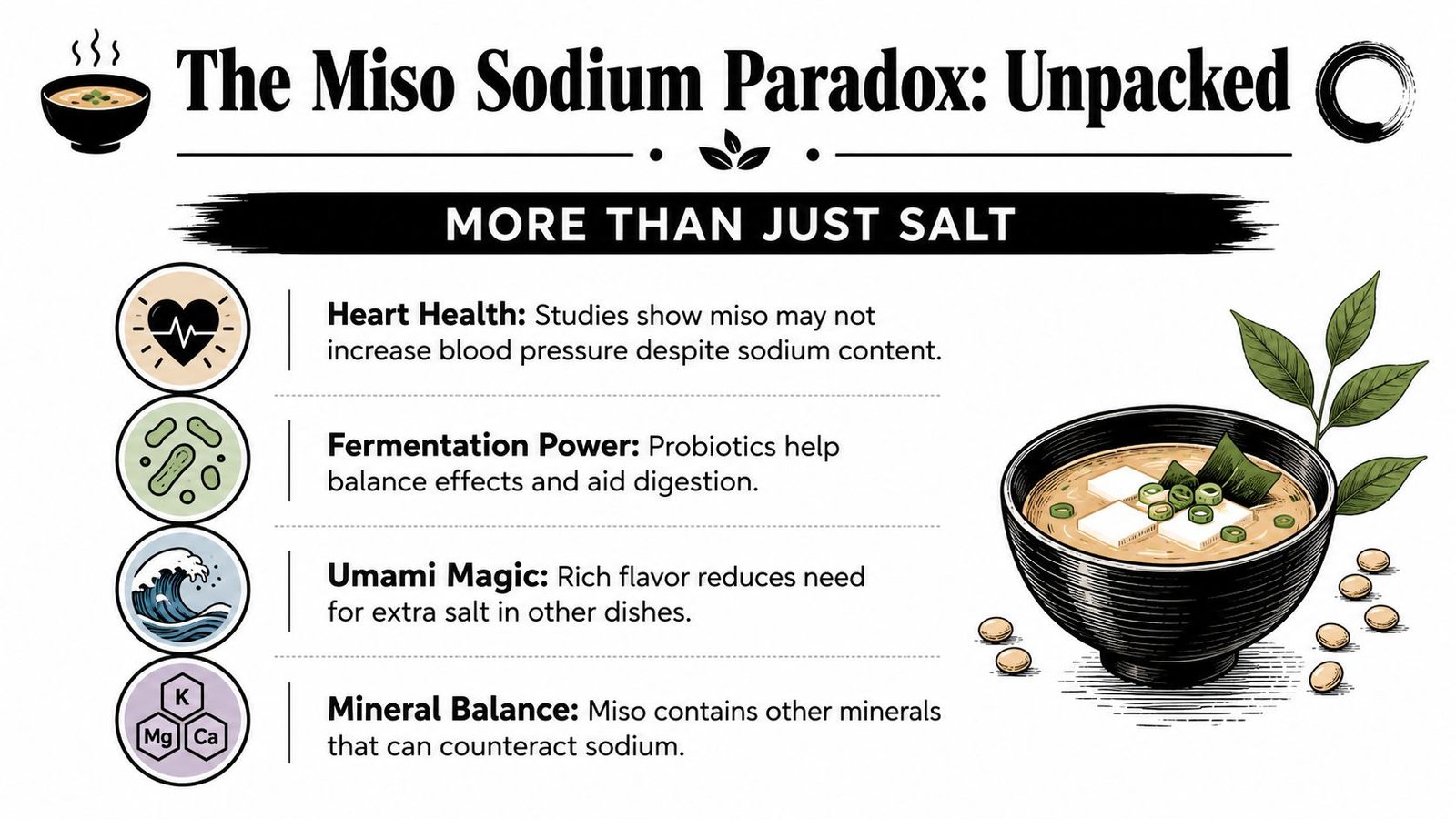
That doesn't mean miso soup is a free pass to ignore sodium. It means researchers have found enough to suggest that miso may partly offset some of the blood-pressure burden you'd expect from salt alone.
Why this doesn't cancel the sodium concern
Here's where nuance matters. The same review also states that observational studies in people with normal blood pressure or mild hypertension did not show a clear effect on blood pressure incidence. So the strongest case is not “miso soup lowers everyone's blood pressure.” The stronger case is that the association with cardiovascular benefit is real enough to take seriously, and the mechanisms are plausible.
Key idea: The sodium paradox isn't proof that salt stops counting. It's evidence that the source and context of sodium can matter.
An easy analogy is coffee with sugar versus a pastry that contains sugar. If you isolate one nutrient and ignore the whole food, you often miss how the body responds in actual eating patterns. Miso soup may behave more like a structured food than like a spoonful of sodium chloride dissolved in water.
A practical way to interpret the paradox
For everyday eating, I'd translate the paradox like this:
- Small servings make sense because miso soup delivers concentrated flavor and soy compounds without needing a huge volume.
- The rest of your diet matters because a salty soup inside an otherwise balanced pattern is different from stacking several salty packaged foods in one day.
- Homemade changes the picture since you can dilute broth, use less paste, and add vegetables or tofu.
- Instant soup deserves more scrutiny because convenience foods can pile sodium into a meal very quickly.
That's why the common advice to label miso soup “healthy” or “too salty” falls short. Both statements flatten a more interesting reality. Miso soup seems to be one of those foods where the whole package matters more than one nutrient line on its own.
How to Enjoy Miso Soup the Healthy Way
The healthiest way to eat miso soup is to treat it as a small, strategic part of a meal, not a limitless broth you keep refilling. That mindset solves most of the confusion.
Build the bowl around volume, not extra paste
Start with a modest amount of miso paste and add bulk through ingredients that don't push sodium higher. Tofu, mushrooms, bok choy, scallions, seaweed, and other vegetables make the bowl feel fuller and more balanced.
If you want a simple framework, use this:
- Keep the broth modest so the salty part stays controlled.
- Add tofu or edamame if you want the soup to feel more satisfying.
- Use vegetables generously to turn a side dish into something with more staying power.
- Taste before adjusting because many people add more paste out of habit, not need.
If miso is the soundtrack, vegetables and tofu should be the main scene.
Choose preparation methods that help
Cooking technique matters because miso is usually stirred in near the end rather than boiled hard. If you're building a meal around steamed greens, tofu, or dumplings, tools like healthy cooking steamers can make it easier to prep add-ins without turning the whole meal oily or heavy.
For people who like quick pantry cooking, broth shortcuts can help too, but they can also push sodium higher if you stack them carelessly. If you use cubes, powders, or concentrates alongside miso, it helps to understand how to use bouillon cubes without accidentally doubling up on salty ingredients.
Match the soup to your goal
Different goals call for different bowls.
If you're trying to eat lighter, keep miso soup as a side and pair it with a protein and rice or a vegetable-heavy plate. If you want a more filling lunch, add tofu and extra vegetables rather than extra miso. If you're watching blood pressure closely or following a salt-restricted plan, homemade gives you far more control than instant packets.
The big idea is simple. Miso soup works best when you use it for flavor density, not for sodium volume.
Quickly Track Miso Soup with PlateBird
Miso soup is one of those foods that sounds simple until you try to log it. Then it turns into a moving target.
A restaurant bowl with tofu, wakame, and mushrooms is not the same as a thin homemade version, and neither matches an instant packet. Even if two bowls look similar, the nutrition can shift a lot based on how much miso paste was used, how concentrated the broth is, and what ended up in the bowl. That matters even more with miso because the health story is not just about “salt” in the abstract. It is about the whole package you ate.
Why soup logging gets messy fast
Mixed dishes rarely fit neatly into a single database entry. An apple is straightforward. Miso soup is more like a playlist with changing tracks. Broth, tofu, seaweed, mushrooms, noodles, and egg each change the final nutrition picture.

Logging the dish as you actually ate it gives you a more useful estimate than picking a random generic entry. If you want to see the mechanics, how PlateBird handles mixed dishes like soups and stir-fries explains why bowls like miso soup are harder to track than single-ingredient foods.
What to pay attention to when you log it
A few details make the biggest difference:
- Whether it was instant, restaurant-made, or homemade
- Whether the bowl was mostly broth or included tofu, noodles, or other add-ins
- How large the serving was
- Whether you finished the broth
That last point is easy to miss. With miso soup, much of the sodium is dissolved in the liquid, so drinking every spoonful is different from eating the tofu and vegetables while leaving some broth behind.
If you are trying to make sense of the sodium paradox for your own diet, this is the practical takeaway. Tracking helps you separate “miso soup” as a label from the meal you consumed. That gives you a clearer picture of how often it fits into your routine, how filling it is, and whether your version is a light side bowl or a saltier, more concentrated one.
The Final Verdict on Miso Soup
So, is miso soup good for you? Usually yes, with context.
It's a light, flavorful food built from fermented soy. It provides soy isoflavones, fermentation-related compounds, minerals, and B-vitamins, and its health reputation is supported by population research that goes beyond trendy probiotic claims. At the same time, it's not a low-sodium free-for-all.
The most important lesson is the sodium paradox. Miso soup contains meaningful salt, yet research suggests it doesn't behave exactly like plain salt in isolation, and it has been associated with favorable cardiovascular outcomes in Japanese studies. That's not a magic trick. It's a reminder that foods work as packages, not just as single nutrients.
Moderation with intention is the smart answer. Keep portions sensible, use homemade versions when you want more control, and build the meal around vegetables and protein instead of extra paste. Used that way, miso soup can absolutely be part of a healthy diet.
If you want an easier way to log meals like miso soup, PlateBird keeps it simple. You can type what you ate or snap a photo, and it helps estimate calories and macros without the usual database scavenger hunt. For mixed dishes, that can make consistent tracking much easier.