You're probably in one of two places right now. Either you haven't started yet and jogging feels like something fitter people do, or you've started and you're wondering why the effort hasn't turned into the results you expected.
Both situations are normal.
Jogging for weight loss works, but not in the simple way often hoped. It can help you lose fat, improve fitness, and build momentum fast. It can also stall if you expect it to carry the whole job by itself. The people who do well with it usually stop treating jogging like punishment and start treating it like a repeatable system. They jog enough to create a real training effect, eat in a way that supports the goal, and adjust when progress slows.
That last part matters. Most advice stops at “just keep running.” That's where people get frustrated, overdo it, or quit. A better approach is to use jogging well in the beginning, then recognize when its role changes from active fat loss to weight maintenance. That's not failure. That's how long-term success usually looks.
From the Couch to Your First Kilometer
A lot of beginners watch runners in the park and assume they're looking at a different species. They're not. Most started with heavy legs, shallow breathing, and the private fear that they'd be the person who had to stop after a minute.
That's why the first step matters more than the first fast run. You don't need to prove anything on day one. You need a reason to believe the effort will pay off.

The good news is that jogging isn't just “better than nothing.” In physically inactive adults, endurance running, including jogging, reduced body mass by an average of 3.3 kg and body fat by 2.7% after one year of training, according to this meta-analysis on habitual running and body composition. In that same research, runners who averaged over 5 km per week and paired training with a targeted diet change achieved a 5.58 kg reduction in fat mass.
Those numbers matter because they replace wishful thinking with a realistic promise. Not instant. Not dramatic in two weeks. But real.
What beginners usually get wrong
It is common to make one of two mistakes at the start:
- They go too hard: They try to jog continuously, their breathing spikes, their calves tighten up, and they decide they're “not built for running.”
- They stay vague: They tell themselves they'll “run more,” but no day, route, or plan is attached to that idea.
A beginner does better with structure than motivation. If you want a practical companion piece on the mechanics of getting started, Flourish-Everyday's guide to beginner running is a useful read because it focuses on the habits that make early consistency possible.
Practical rule: Your first goal isn't to run far. It's to finish feeling like you could do it again.
What success looks like early on
Early success in jogging for weight loss often looks unimpressive from the outside. You walk part of the session. You repeat short routes. You keep the pace easy. But inside your body, that easy work is doing the heavy lifting. It builds aerobic capacity, raises your tolerance for regular training, and helps you create a routine you can keep long enough to matter.
That's how the first kilometer happens. Not through grit alone, but through patience.
Setting Yourself Up for Success Before You Start
Beginners often obsess over the workout and ignore the setup. That's backwards. Good setup removes friction, and friction is what kills consistency.
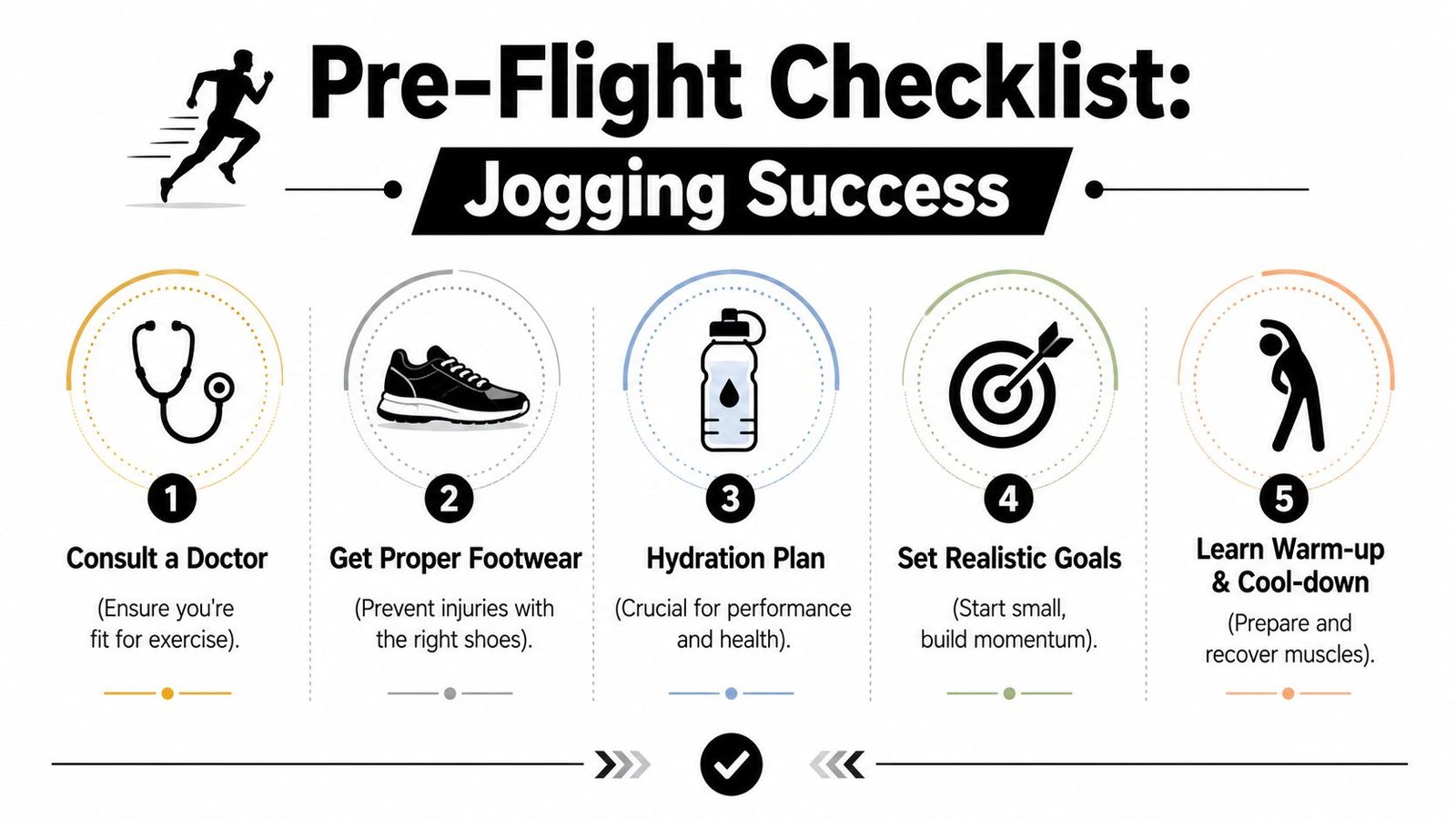
Before your first week starts, get three things clear: your goal, your shoes, and your routine.
Set a goal that can survive a bad week
“Lose weight” is a fine reason to start, but it's not a working plan. A working plan tells you what you'll do when work runs late, it rains, or motivation drops.
Use a goal that combines outcome and behavior:
- Outcome goal: lose fat, improve waist fit, feel lighter on stairs
- Behavior goal: complete your scheduled jogging sessions each week
- Process goal: prepare clothes and shoes the night before
The behavior goal matters most in the beginning because it gives you something you can win every week, even before your body visibly changes.
Buy less gear than you think
New runners often waste energy comparing watches, headphones, belts, and apps. You do not need a lab setup to begin.
Start with these:
- A proper pair of running shoes: Comfort matters more than hype. If a shoe irritates your foot in the store, it won't magically improve on the road.
- Simple clothing you will wear: If it chafes, rides up, or makes you dread the session, it's the wrong kit.
If you have medical concerns, joint pain, or a long history of weight struggles, getting personal guidance before diving in can help. Some people do better when jogging sits inside a broader plan, and personalized weight management plans can be worth exploring in that case.
Build your routine before motivation fades
Many joggers don't skip runs because they're lazy. They skip runs because the decision shows up at the wrong time.
Use a pre-commitment checklist:
- Choose your days now: Put them on your calendar like appointments.
- Pick one route: Remove the daily “where should I go?” debate.
- Decide your trigger: After work, before breakfast, after school drop-off. Tie the jog to an existing part of your day.
- Plan your recovery meal: Hunger after training can wreck the rest of the day if you leave it to chance.
- Track food: If nutrition feels messy, a guide on calorie tracking for runners can help you avoid the common mistake of running consistently while eating inconsistently.
Most beginners don't need more willpower. They need fewer decisions.
The best starting mindset
Treat the first month like skill practice, not a body transformation contest. You're learning how to pace yourself, recover, and repeat. That mindset keeps you from overreaching and makes it much easier to stack enough good weeks together for weight loss to happen.
Your First Four Weeks A Progressive Jogging Plan
The fastest way for a beginner to fail is to turn the first session into a fitness test. Don't do that. A better plan is a walk-jog progression that keeps effort controlled and lets your joints, lungs, and confidence adapt together.
The other reason this approach works is that dose matters. A large meta-analysis of 109 trials found that every 30 minutes per week of aerobic exercise like jogging is associated with about 0.5 kg of weight loss, and 90 minutes per week is associated with roughly 1.5 kg of weight loss over time, according to this review of aerobic exercise dose and weight loss. That doesn't mean every individual gets the exact same result. It does mean your weekly volume matters, and it rewards consistency.
The four week progression
Use this plan three times per week on non-consecutive days. Every session includes a 5 minute walk warm-up and 5 minute walk cool-down.
| Week | Session Details (Warm-up + Cool-down: 5 min walk each) | Total Time |
|---|---|---|
| Week 1 | 6 rounds of 1 min jog, 2 min walk | 28 min |
| Week 2 | 6 rounds of 90 sec jog, 2 min walk | 31 min |
| Week 3 | 5 rounds of 3 min jog, 2 min walk | 30 min |
| Week 4 | 4 rounds of 5 min jog, 90 sec walk | 31 min |
This progression does two things well. It keeps the sessions long enough to build an aerobic base, and it prevents the classic beginner error of running hard every time.
How each run should feel
Your jogging segments should feel controlled enough that you could still speak in short phrases. If you're gasping, you're not building the right engine yet. You're just surviving the workout.
Use these cues:
- Easy means easy: You should finish with some energy left.
- Walking isn't failure: It's part of the plan.
- Repeatability wins: If you can't imagine doing the session again in two days, it was too hard.
A beginner who jogs gently three times a week usually gets farther than the beginner who destroys one workout and disappears for five days.
What to do on the days in between
Don't turn every off day into another workout. Let your body absorb the training.
Good options include:
- Easy walking: Helps recovery without adding much strain
- Light mobility work: Ankles, calves, hips
- Nothing at all: Rest is productive when you're adapting to a new routine
If you're curious about energy cost and why pace changes the feel of a run, this breakdown of how many calories running a mile burns gives useful context without making the mistake of reducing training to a simple calorie equation.
When to repeat a week
Repeat a week if your shins ache, your breathing is out of control, or the sessions leave you excessively sore. There's no penalty for staying at one level longer. There is a penalty for forcing progression your body hasn't earned.
By the end of four weeks, many people can jog continuously for longer stretches than they expected. More important, they've built a routine that feels normal. That's the base you need before chasing bigger fat-loss goals.
Why You Cant Outrun a Bad Diet
This is the point where many motivated beginners get annoyed. They've started jogging, they're sweating, they feel healthier, and yet the scale barely moves. The usual response is to run more.
That's often the wrong fix.

For meaningful weight loss through jogging alone, you generally need to exceed 300 minutes per week of moderate aerobic exercise. But combining 150 minutes per week of jogging with a modest 300 to 500 kcal daily deficit can produce double the fat loss, around 5 to 8 kg versus 1.5 to 3.5 kg over time, according to the JAMA Network Open review on aerobic exercise and weight loss. That's the trade-off in plain terms. Exercise helps, but food intake decides whether the math works.
Why runners stall on the nutrition side
Jogging can create a false sense of dietary freedom. People finish a run and unconsciously “spend” the effort on snacks, oversized dinners, or drinks that wipe out the deficit.
The problem usually isn't lack of discipline. It's lack of structure.
Common mistakes look like this:
- Eating reactively after every run: Hunger makes the decision, not the plan.
- Overestimating what the run earned: A hard session feels bigger than it is.
- Ignoring protein: Weight goes down, but muscle loss and poor recovery come along with it.
- Letting weekday effort disappear on weekends: One loose stretch can erase several good days.
Protein is not optional
If you want jogging for weight loss to improve body composition instead of just lowering body weight, protect lean mass. One useful benchmark is maintaining protein intake at 1.6 to 2.2 g/kg of body weight daily, as discussed in this running and weight loss guide.
That gives you two advantages:
- better recovery from your sessions
- a better chance of losing fat without feeling flat, hungry, and weak
Aggressive restriction tends to backfire. The same guide warns against large deficits above 500 kcal/day, because training quality drops and hunger often rebounds later.
Coach's note: If your runs keep getting worse, don't assume you need more discipline. You may need better fueling and a smaller deficit.
Keep the diet simple enough to repeat
A good fat-loss nutrition plan doesn't need to look fancy. It needs to be boring in the right ways.
Use a simple framework:
| Meal | What to prioritize | Why it works |
|---|---|---|
| Breakfast | Protein first | Helps manage hunger early |
| Lunch | Protein plus high-volume foods | Keeps the afternoon under control |
| Dinner | Repeat the same structure | Reduces random overeating |
| Post-run snack | Planned, not impulsive | Stops “reward eating” |
If you want a non-dogmatic perspective on cleaning up food choices without getting trapped in diet culture, Justin Nault's weight loss tips offer a useful contrast to the usual “burn more, eat less” cliché.
A strong place to start is understanding what a deficit is and how to create one without wrecking training. This guide to what a calorie deficit is is helpful for that.
A short demonstration helps make the nutrition side more practical:
What works better than trying to be perfect
You don't need clean eating sermons. You need meals you can repeat on busy days. The runners who make this work usually choose a few dependable breakfasts, a few dependable lunches, and enough protein at each meal to stay full and recover.
Jogging drives the activity side. Diet drives continued fat loss. When you accept that division of labor, progress gets steadier and a lot less frustrating.
Navigating Plateaus and Increasing Intensity
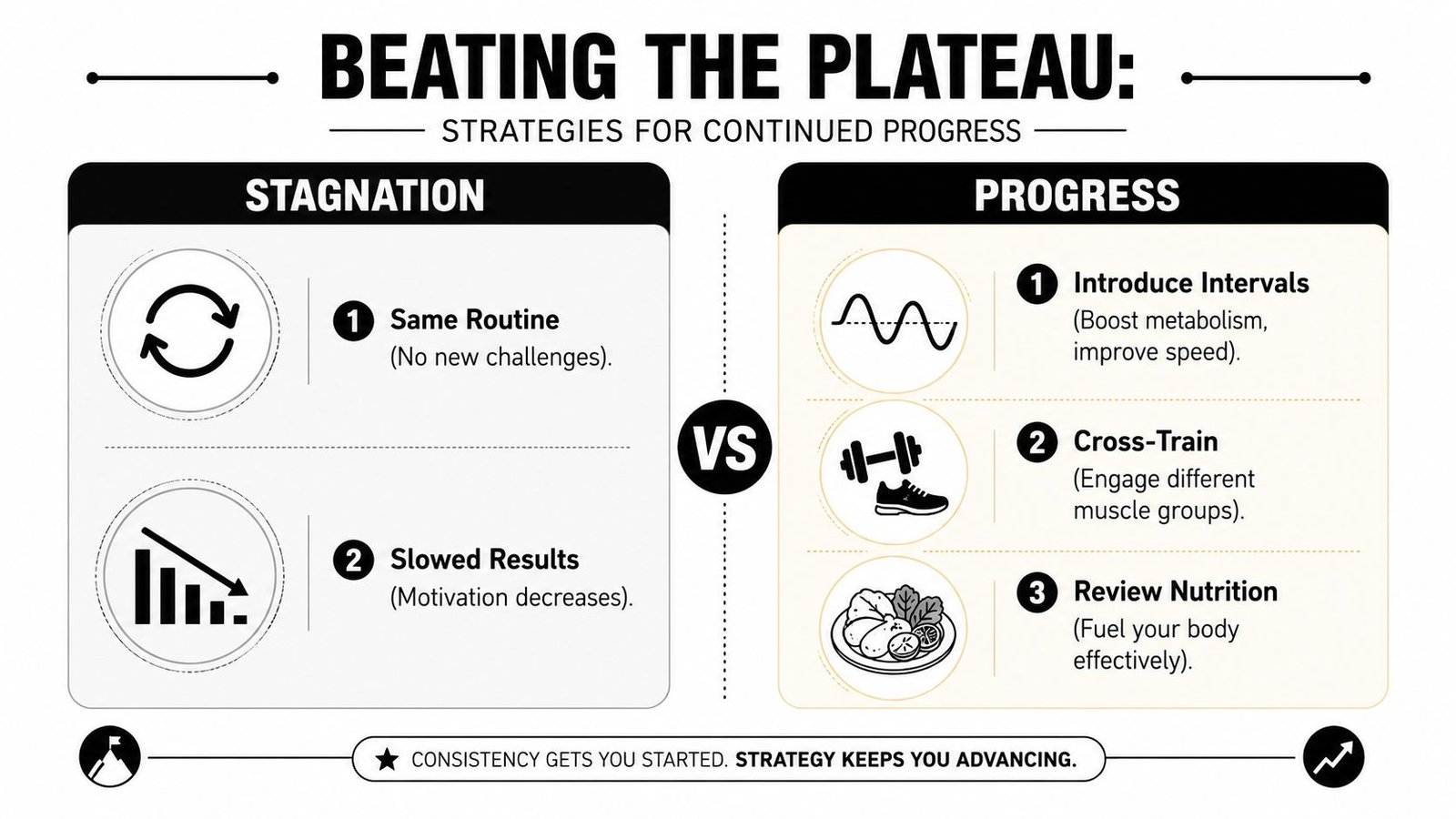
After the early wins, many runners hit the same wall. They're still jogging, still sweating, still showing up, but the body changes slow down. This isn't a sign that jogging stopped “working.” It's a sign that your body adapted.
New research summarized by Medical News Today's review of running and weight maintenance notes that running can produce short-term weight loss, then plateau. Its longer-term value is often weight maintenance, not endless loss.
That's the ceiling effect. If you don't understand it, you'll keep trying to solve a nutrition problem with more mileage.
The strategic shift that keeps people progressing
Early on, jogging helps create the deficit. Later, jogging often becomes the habit that protects your new body weight while nutrition does more of the work for active loss.
That shift is important because it changes how you judge your runs. Instead of asking, “Did this session make me lose more weight?” ask, “Did this session help me stay active, preserve fitness, and support the body I'm building?”
Those are not consolation prizes. They're the foundation of staying lean.
How to change training without blowing yourself up
When a plateau hits, don't overhaul everything at once. Change one variable.
Useful options:
- Add one interval session: Replace one steady jog with short faster efforts separated by easy recovery.
- Keep most runs easy: Hard sessions work because they're occasional, not constant.
- Use cross-training sparingly: A bike, rower, or brisk walk can add activity without extra impact.
- Review food quality and portions: Plateaus often reveal eating drift more than training failure.
More effort isn't always better. Better structure is better.
Steady jogging versus intervals
Both have a place.
| Approach | Best use | Main caution |
|---|---|---|
| Steady easy jogging | Building volume, recovery, habit | Can become stale if every run feels the same |
| Intervals | Breaking monotony, improving fitness, adding challenge | Too much intensity drives fatigue and hunger |
If you're a beginner or recently consistent, steady jogging should still be your default. Intervals are seasoning, not the whole meal. One harder session each week is usually plenty for someone focused on fat loss rather than race performance.
What a plateau actually means
A plateau doesn't mean your body is stubborn or broken. It means your current input now matches your current adaptation. You either need a dietary adjustment, a small training change, or both.
The mistake is getting emotional and making the next month harder than necessary. The better move is calm analysis. Keep jogging. Accept its role in maintenance. Tighten the food side. Add variety carefully. That's how people move forward without burning out.
Making It a Habit Recovery and Consistency
The old “no pain, no gain” mindset ruins more running plans than bad shoes do. Weight loss doesn't reward the person who suffers most. It rewards the person who keeps going long enough.
Recovery is part of the job. If your calves stay tight, your sleep gets worse, and every session starts with dread, your plan is too aggressive. Back off before your body forces the decision for you.
What recovery should look like
Good recovery is simple:
- Respect soreness: Mild muscle fatigue is normal. Sharp or worsening pain is not.
- Keep easy days easy: Don't race your recovery jogs.
- Protect sleep: Tired people make worse food choices and train poorly.
- Stay consistent with meals: Under-eating early in the day often turns into overeating later.
What keeps the habit alive
The runners who stay with it usually rely on systems, not moods.
Try these:
- Schedule runs at the same time when possible: Routine reduces negotiation.
- Track wins beyond the scale: Energy, breathing, mood, and how clothes fit all matter.
- Use default routes: Familiarity lowers resistance.
- Stop chasing punishment workouts: The best run is the one that fits your life well enough to repeat.
You do not need to love every run. You need to make each run easy enough to start again tomorrow or the next day.
Jogging for weight loss works best when it stops being a dramatic event and becomes part of ordinary life. That's where lasting results come from. Not from one heroic month, but from enough steady months chained together that the habit starts carrying you.
If you want the nutrition side to be as simple as the running side, PlateBird makes food logging fast enough to stick with. You can type a meal like “eggs toast coffee” or “chicken rice broccoli,” get calories and macros instantly, and keep an eye on the protein and calorie targets that support fat loss. For busy people trying to balance training, work, and real life, that kind of low-friction tracking can make the difference between guessing and progressing.