A standard 6-inch corn tortilla usually lands around 60 to 70 calories, with one common listing at 67.8 calories. But that number shifts more than many consumers expect, because corn tortillas calories change with size, brand, and how the tortilla is cooked.
That's why taco night can get confusing fast. You pull tortillas from the package, open your tracking app, and suddenly see several entries that don't match each other. One says a tortilla is tiny. Another assumes a larger serving. A restaurant taco might use two tortillas, while the package in your kitchen uses one thicker tortilla that weighs much more.
Many individuals do not struggle because of an inability to count calories. Rather, the challenge arises when attempting to log a food that appears simple but varies significantly in practice. Corn tortillas are a perfect example. The correct approach is not to memorize a single number, but to learn how to identify which version is being consumed.
The Corn Tortilla Calorie Question
Tacos make this problem obvious.
You build a plate with grilled chicken, salsa, onions, and a couple of corn tortillas. That sounds straightforward until you try to log it. Are these street taco tortillas? Standard 6-inch tortillas? Thick restaurant tortillas? Were they warmed dry, or fried before serving? Those details change the calorie total enough to matter.
One of the biggest mistakes I see is treating all tortillas as interchangeable. They aren't. In one set of common references, corn tortillas calories range from 52 calories for a 24 g tortilla to roughly 96 calories for a 44 g tortilla, and deep-fried tortillas can rise to 107 to 150 calories. That also means a two-tortilla taco can differ by 50%+ depending on which tortillas are used, which is exactly why meal logging gets messy if you use a generic entry from memory (calorie ranges for different corn tortilla sizes and fried versions).
Practical rule: If your entry just says “corn tortilla” and nothing else, there's a good chance it's too generic to be accurate.
That matters most when you're trying to stay in a calorie deficit. If you need a refresher on how calorie intake drives fat loss, this guide can help you understand the foundation of weight loss without turning meals into math homework.
Why one number fails
A tortilla's calorie count changes for a few simple reasons:
- Size changes the total. A smaller tortilla and a larger one can both be called “corn tortilla,” but they won't log the same.
- Thickness changes the weight. Two tortillas with a similar diameter can still carry different calories if one is denser.
- Preparation changes everything. A dry-heated tortilla is one food. A fried shell is another.
- Meal context matters. Two small tortillas used for one taco can easily outpace one larger tortilla.
If you're trying to estimate food more precisely, it helps to learn how calories relate to gram weight. That's the skill that makes tortilla logging much less frustrating.
What works better
Don't chase the “perfect” universal tortilla number. Match the entry to the tortilla in front of you.
Look at the package if you have it. Notice whether the taco uses one tortilla or two. Ask whether the tortilla was fried or just warmed. Those small checks usually beat endless searching in a food database.
A Corn Tortilla's Nutritional Profile
A plain corn tortilla is a fairly compact food. It gives you carbohydrates first, a small amount of protein, very little fat, and some fiber. That's one reason it fits well into many calorie-controlled meals. It's not calorie-free, but it also doesn't take up a huge share of your budget unless portions drift.
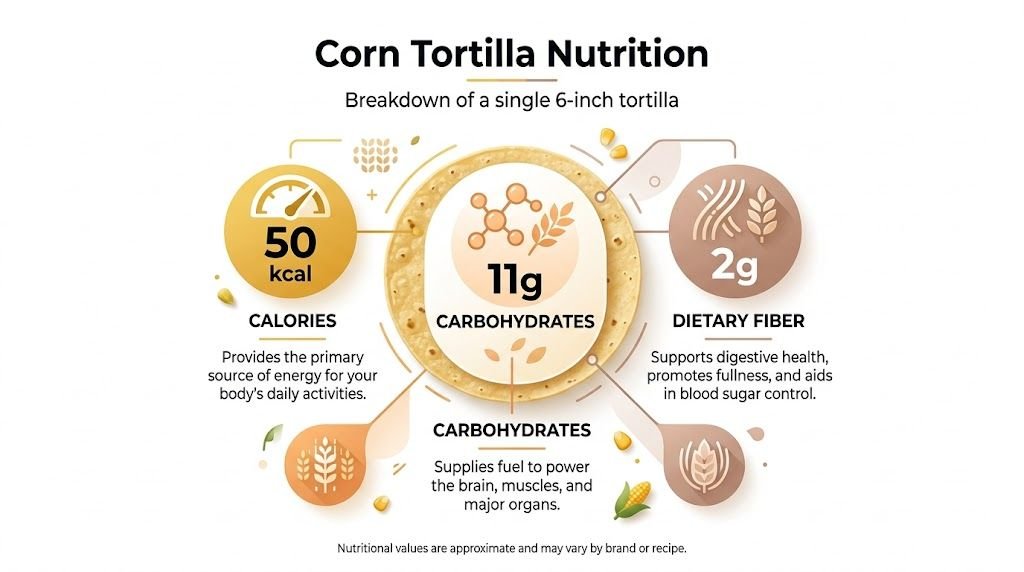
For a reliable baseline, a 6-inch corn tortilla contains 67.8 calories, 12.8 g of carbohydrates, 2.0 g of protein, 0.9 g of fat, and 2.0 g of fiber according to one foodservice nutrition listing (6-inch corn tortilla nutrition facts).
The baseline numbers that matter
That 6-inch example gives you a useful mental shortcut. If you're eating a standard plain corn tortilla, think of it as roughly:
- About 68 calories
- 12.8 g carbs
- 2.0 g protein
- 0.9 g fat
- 2.0 g fiber
That profile explains why corn tortillas show up often in simple meal plans. They provide structure and carbs for a meal without adding much fat on their own.
Why size changes your log
The problem starts when people assume every tortilla is that standard size.
The same source shows that a 28 g tortilla has about 62 calories, while a 44 g tortilla has about 96 calories. In practical terms, doubling tortilla weight can increase calories by over 50% in common products, which is why eyeballing them can lead to under-logging when you buy a thicker brand or order tacos from a restaurant that uses larger tortillas (same source as above).
A tortilla is better logged by its size or weight than by its name alone.
Here's a quick reference:
| Tortilla type | Approximate calories |
|---|---|
| Smaller tortilla, 28 g | 62 |
| Standard 6-inch tortilla | 67.8 |
| Larger tortilla, 44 g | 96 |
A simple way to think about it
If the tortilla looks small and light, it's often closer to the lower end. If it looks broad, thick, or dense, it may be much closer to the higher end. That sounds obvious, but it's the difference between an honest log and a wishful one.
This is also why nutrition labels are more helpful than app search results when you have the package. The package tells you what is in your kitchen. The database often tells you what somebody else ate.
Corn Versus Flour Tortillas
If your goal is calorie control, the corn versus flour decision matters.
This isn't about labeling one food “good” and the other “bad.” It's about matching the tortilla to your goal. If you want a lighter base for tacos, corn usually gives you more room for fillings. If you care more about softness or a larger wrap format, flour may still fit. You just need to log it accurately.
A published comparison from Healthline lists a 44 g corn tortilla at 95.9 calories and 1.25 g fat, while a 45 g flour tortilla has 138 calories and 3.6 g fat. The corn tortilla also has 2.77 g fiber versus 1.58 g for flour, which makes corn the lower-calorie, lower-fat option in that side-by-side serving comparison (corn and flour tortilla nutrition comparison).
Nutrition Face-Off Corn vs. Flour Tortilla per ~45g serving
| Nutrient | Corn Tortilla (44g) | Flour Tortilla (45g) |
|---|---|---|
| Calories | 95.9 | 138 |
| Fat | 1.25 g | 3.6 g |
| Fiber | 2.77 g | 1.58 g |
What that means on your plate
If you swap flour for corn in a meal built around tacos, you usually create more calorie room for the foods that add satisfaction, such as grilled meat, beans, avocado, or cheese. That doesn't mean you should always pick corn. It means the tortilla itself shouldn't take more calories than you intended.
Corn tortillas often work better when the goal is to keep the shell lighter and let the filling do the heavy lifting.
There's also a texture trade-off. Flour tortillas are usually softer and more flexible. Corn tortillas bring a more distinct corn flavor and often pair better with classic taco-style meals. Some people digest or prefer one better than the other. That's a valid reason to choose it.
When flour still makes sense
Flour tortillas can still fit well if:
- You want a burrito-style wrap. Corn usually doesn't behave the same way structurally.
- You're planning around one larger tortilla. Some people prefer one substantial wrap over several smaller tortillas.
- Taste wins. A meal plan that feels realistic is easier to stick with than one built on food you don't enjoy.
The key is to stop assuming “tortilla” is nutritionally neutral. It isn't. The shell changes the meal.
How Toppings and Cooking Change Everything
A plain tortilla rarely stays plain for long. Once oil, fillings, cheese, and sauces enter the picture, the calorie story changes fast.
The first place people underestimate a taco is the tortilla itself after cooking. A small corn tortilla can start fairly modest, but preparation can push it much higher before anything goes inside.
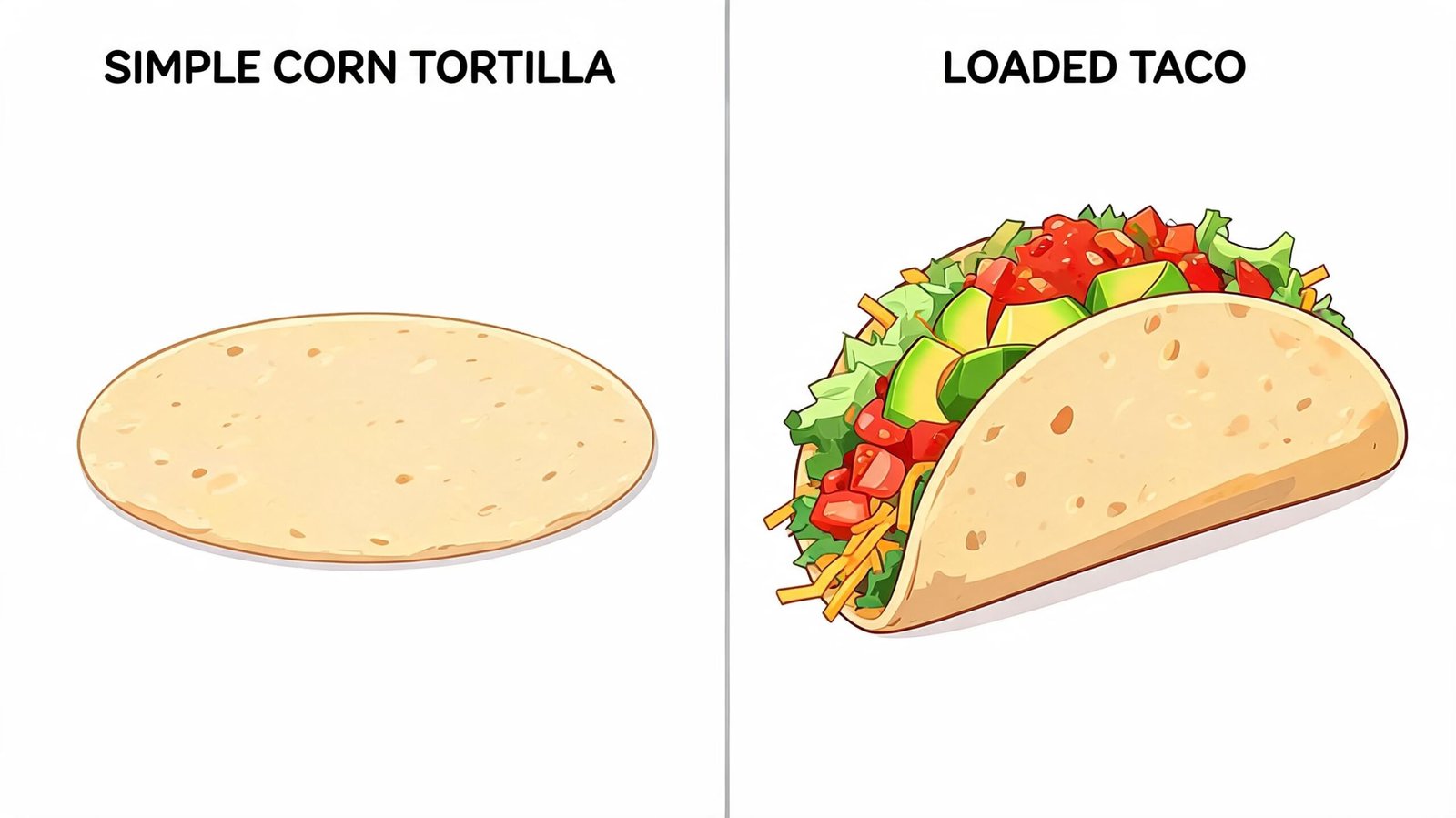
A common reference puts corn tortilla calorie density at around 220 to 265 kcal per 100 g. In that same set of entries, a small 26 g corn tortilla has about 58 kcal, but deep-frying can raise it to 107 to 150 kcal. In other words, cooking method can nearly double the tortilla calories before you add meat, beans, or toppings (how frying changes corn tortilla calories).
Dry heat and steaming versus frying
If you're watching corn tortillas calories closely, dry heat wins almost every time. Warming tortillas on a skillet, griddle, or directly over heat keeps the tortilla close to its original calorie level. Steaming or wrapping them in a towel after heating changes texture, not the calorie total in any meaningful way.
Frying is different. Oil changes the food, not just the texture. A taco shell that tastes light and crisp can carry much more energy than the soft tortilla it started as.
That's why restaurant tacos can be deceptive. Even when the ingredients sound simple, the cooking method may be doing more work than the filling.
The real calorie creep happens above the tortilla
Focusing on the tortilla is common because it is easy to count. The more important question is what gets stacked on top.
Here's what usually helps in practice:
- Choose your splurge on purpose. If you want cheese, keep the creamy sauces lighter. If you want avocado, skip the extra oil.
- Let lean protein anchor the meal. Chicken, fish, beans, or other lean fillings usually make logging simpler than heavily fried fillings.
- Pile on salsa and crunchy vegetables. They add volume and flavor without turning the taco into a guessing game.
- Watch restaurant-style finishing touches. Oil-brushed tortillas, crispy shells, melted cheese, and creamy drizzles are where many meals drift.
If you eat out often, this guide on estimating calories when eating at restaurants is useful because tacos are one of those meals where preparation details matter more than the menu label suggests.
A quick visual can help make that difference obvious:
The tortilla is the base. The cooking method and toppings decide whether the meal stays light or turns into a calorie-heavy plate.
Practical Tips for Portion Sizing
Portion sizing matters more than food labels when tortillas are involved.
That's because tortillas are easy to stack, easy to refill, and easy to underestimate. A meal can look modest but still climb if you use larger tortillas, double-wrap tacos, or eat straight from a communal platter without noticing how many you've gone through.
Use visual consistency, not guesswork
The best habit is boring and effective. Serve the number of tortillas you plan to eat, then put the package away. People tend to track better when the portion is visible on the plate instead of available in an open stack on the table.
A few practical habits work well:
- Pick one tortilla format and learn it. If you regularly buy the same brand and size, logging gets easier because your baseline stops changing.
- Notice whether the taco uses one tortilla or two. Street-style tacos often use two small tortillas. That can still fit your goals, but it needs to be counted as eaten.
- Plate first, refill second. Give yourself a pause before automatically adding more.
- Match tortillas to hunger. On lighter days, smaller tortillas can help you enjoy the meal without overshooting.
Build a meal that feels generous
The easiest way to stay satisfied isn't always using more tortillas. It's making the filling work harder.
Use plenty of protein, vegetables, salsa, cabbage, onion, cilantro, or beans so the taco feels complete. When the filling is well-built, you're less likely to chase fullness with extra tortillas alone.
A satisfying taco meal usually comes from balance, not from stacking more tortillas than you meant to eat.
Another useful check is to watch trends in your body data without obsessing over any single day. If you tend to feel confused by weight fluctuations, it can help to read about how AI scales reveal health truths. That broader perspective keeps one taco night from feeling bigger than it is.
What usually doesn't work
Rigid food rules often backfire.
Calling tortillas “off-limits” may help for a day or two, but it often makes cravings stronger and meals feel less realistic. What works better is choosing the portion deliberately, logging it accurately, and building the rest of the plate with some structure.
That's sustainable. And sustainability beats perfection every time.
Log Corn Tortillas Instantly with PlateBird
Corn tortillas are a small food with a lot of variation. That's exactly why logging them can be annoying in traditional apps. You search “corn tortilla,” scroll through a pile of entries, and still aren't sure whether the result matches the tortilla on your plate.
A faster approach is to log the meal the way you think about it. Instead of hunting for separate entries one by one, you can type the full meal in plain language. “Two corn tortillas with chicken, onions, salsa, and cheese” is much closer to how people eat than “tortilla, tortilla, chicken, cheese, salsa” as separate searches.
Text logging works best when you know the details
If you know the meal, type the details that matter most:
- Number of tortillas
- Corn, not flour
- Fried or not
- Main filling
- High-calorie extras like cheese or creamy sauce
That solves the exact problem this article has been addressing. The tortilla count, size cue, and cooking method do more for accuracy than a vague generic entry ever will.
Photo logging helps when the meal is in front of you
There's another option when you don't want to type much. A photo-based log can capture the plate as served, which is especially useful for restaurant tacos where tortilla size, double wrapping, and toppings are easier to see than describe.
If you want to see how that style works, this overview of a photo food diary app shows why image-based logging is often easier for mixed meals like tacos, burrito bowls, and loaded plates.
The best food log is the one you'll actually keep using when life gets busy.
The final advantage is repetition. Once you log your go-to taco meal a few times, future entries get much faster because your usual combination is already familiar. That removes friction, and lower friction is what makes calorie tracking stick.
If you want food logging to feel fast instead of tedious, try PlateBird. You can type what you ate in plain English or snap a photo of your meal, which makes variable foods like tacos and corn tortillas much easier to track without digging through endless database entries.