- Why repeatable meals beat complex recipes for macro tracking
- Hack 1: Build every meal around a protein-first base
- Hack 2: Use sheet-pan meals for fast batch cooking
- Hack 3: Pre-portion snacks and add-ons before the week starts
- Hack 4: Make camera-friendly meals for faster photo logging
- Hack 5: Keep 2 to 3 emergency freezer meals ready
- Which prep hack fits your schedule best
- Common mistakes that make macro meal prep harder to track
- Frequently asked questions
You spent Sunday afternoon cooking chicken thighs, roasting vegetables, and dividing everything into six containers. By Wednesday, you have no idea what the macros are because you eyeballed the portions, added a sauce at the last minute, and combined three things into one container that now looks like a single unidentifiable meal. Sound familiar?
That is not a willpower problem. It is a system problem. The prep happened, but the structure that makes tracking easy did not.
The top 5 macro-friendly meal prep hacks covered here are not about recipes. They are about building a prep workflow that keeps portions consistent, ingredients visible, and logging fast, whether you type what you ate or snap a picture to capture it.
Why repeatable meals beat complex recipes for macro tracking
Variety feels motivating on Sunday. By Thursday, it creates a tracking problem. When every meal is different, every log entry requires fresh estimation, and estimation error compounds across the week.
A repeatable meal template takes about 30 seconds to log once you have done it twice. A novel grain bowl with five mixed ingredients and a drizzle of tahini takes much longer and introduces more guesswork.
The goal is not eating the same thing forever. It is keeping the structure the same so the macros stay predictable. Swap the protein from chicken to salmon. Keep the portions identical.
The best prep system is the one you can repeat on a Thursday night when you are tired, not just the one that looks great on Sunday afternoon.
Visible, separated ingredients also matter for AI nutrition tracking apps that read photos. A plate where the chicken, rice, and broccoli each have their own space is far easier to interpret than a mixed bowl where everything merges together.
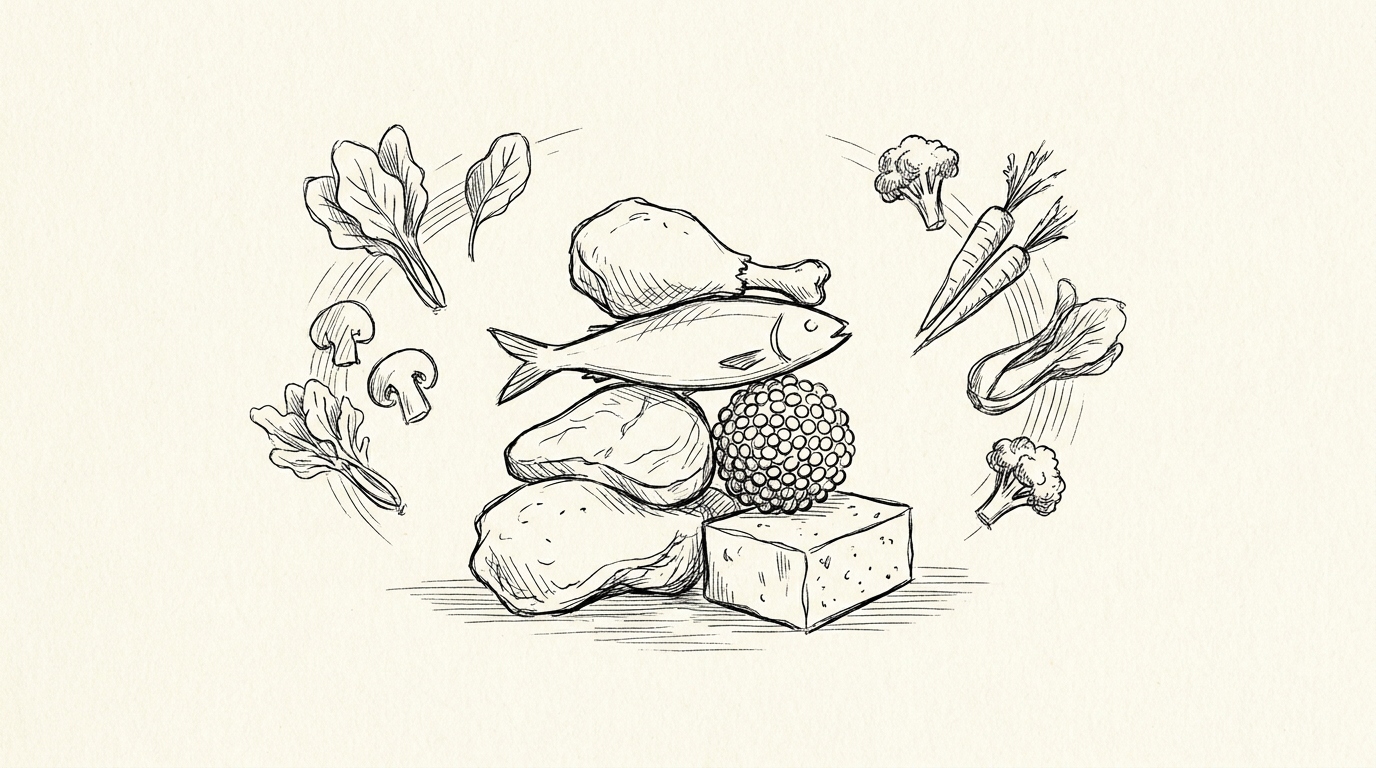
Hack 1: Build every meal around a protein-first base
Pick one lean protein and cook it in bulk
The protein anchor is the most important decision in macro-friendly prep. Pick one lean source per week and cook a large batch of it. Chicken breast, ground turkey, canned tuna, hard-boiled eggs, or baked salmon all work.
Cook 1 kg at once. Divide it into equal portions immediately after cooking, before it goes in the fridge. That single step locks in your protein macro for every meal that uses it.
Add a carb and vegetable in fixed amounts
Once the protein is portioned, the rest follows a formula. A fixed carb sits alongside a vegetable that can be roasted in bulk. Broccoli, zucchini, and bell peppers all hold up well for several days in the fridge without going soggy.
This three-part plate keeps your macros consistent across multiple meals. You are not recalculating every day. You are logging the same template with minor swaps.
Use the same base across lunch and dinner
The protein-first base works across both meals without feeling repetitive if you vary the seasoning or the vegetable. Monday’s chicken with rice and broccoli becomes Tuesday’s chicken with rice and roasted peppers. The macro count stays nearly identical. The logging stays fast. Flexible dieting meal prep guides point to this kind of template-based cooking as the most sustainable approach for hitting protein targets without overthinking every plate.
Hack 2: Use sheet-pan meals for fast batch cooking
One pan, several meals, minimal cleanup
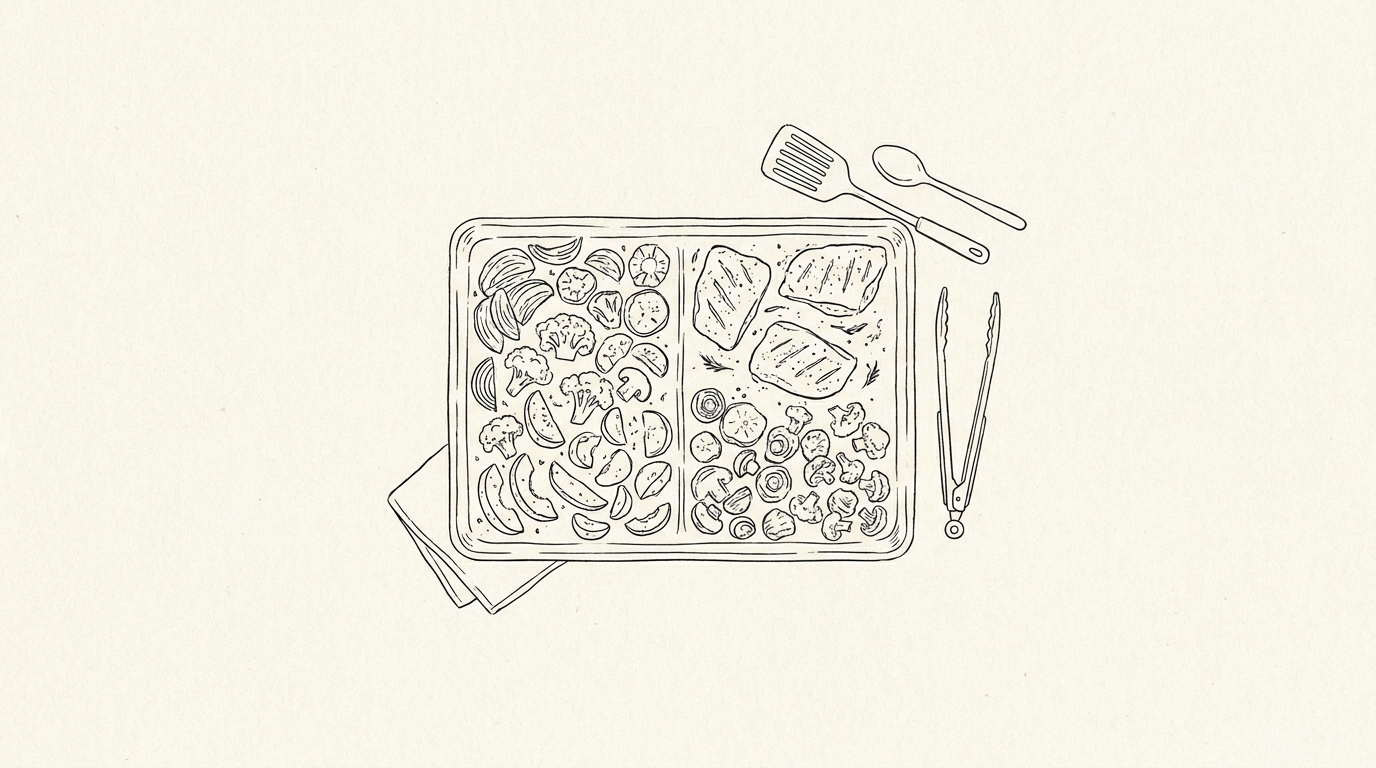
Sheet-pan cooking is the fastest way to batch-cook a macro-friendly meal without standing over a stove. You spread your protein and vegetables across one large pan, season them, and roast everything at around 200°C for 20 to 25 minutes. Active prep time is usually under 15 minutes.
The batch size scales easily. One large sheet pan can hold enough for 3 to 4 meals. Two pans running at once doubles that. Practical prep guides for busy people highlight sheet-pan meals as the go-to method when cooking time, not motivation, is the constraint.
Why sheet-pan meals are easier to log accurately
Ingredients cooked separately on a sheet pan stay visually distinct. The salmon fillet sits next to the asparagus. The turkey sausage rounds sit beside the diced potatoes. That separation is useful when you are logging by photo, because the AI can identify each component without guessing what is buried underneath something else.
Weigh your ingredients before they go on the pan, not after. Cooking removes moisture and changes weight. Weigh raw, log raw weights, and you will be consistent.
Weigh protein before it hits the pan. Cooked weights shift depending on how long something roasts, and that inconsistency quietly throws off your numbers over the week.
Hack 3: Pre-portion snacks and add-ons before the week starts
Small items cause the biggest tracking gaps
Snacks and add-ons are where macro tracking most often falls apart. A handful of almonds feels like a small choice. Thirty almonds is closer to 180 calories and 15 g of fat. A spoonful of peanut butter added to oatmeal without measuring can add 100 to 190 calories depending on the spoon size.
These are not bad foods. They are just easy to underestimate. Pre-portioning them on Sunday removes the decision. You reach for the container, not the bag.
Use containers that match one serving
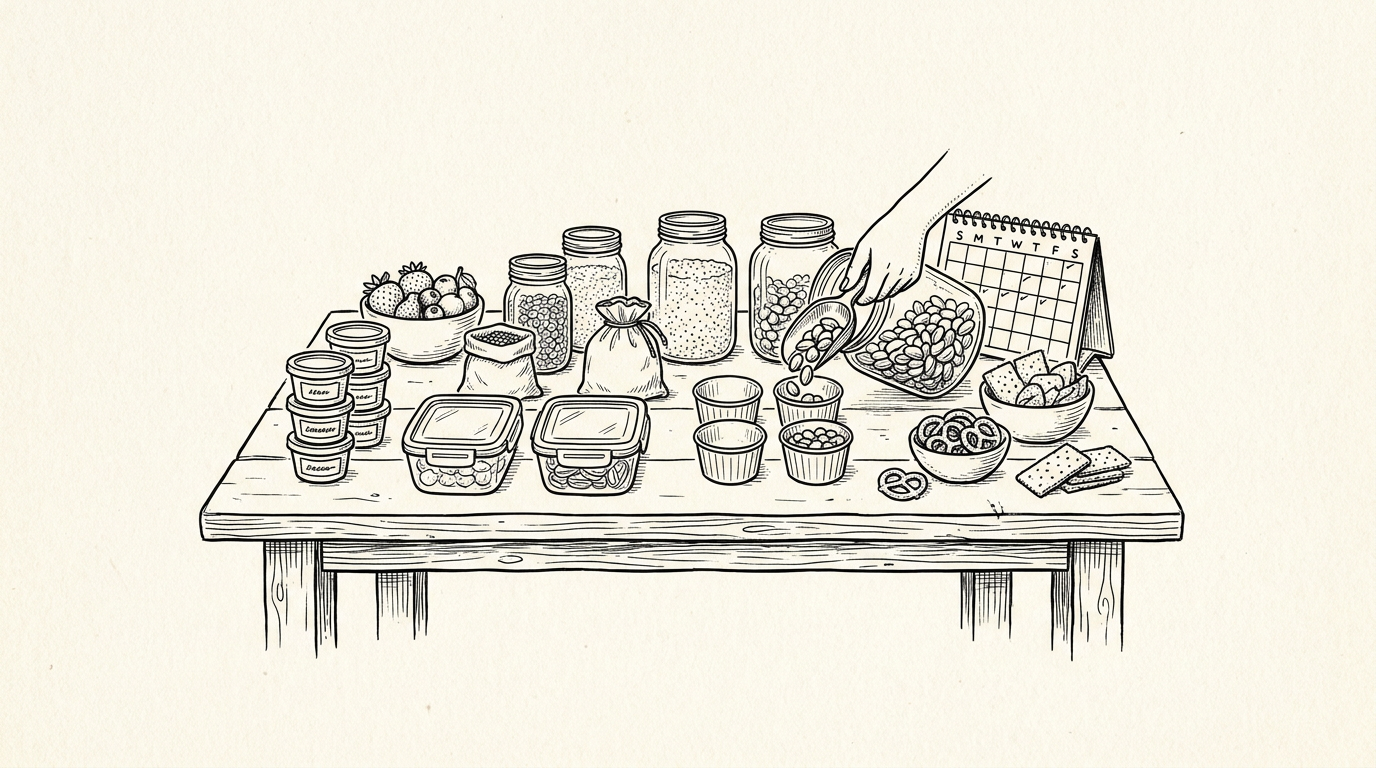
Small snack containers or zip-lock bags work well here. Portion out 28 g of nuts, 150 g of Greek yogurt, one piece of fruit, or 30 g of cheese into individual servings. Label them if it helps. The key is that each container represents exactly one serving with a known macro count, so logging takes seconds rather than minutes.
This approach works well if you snack between meetings or grab food on the go. High-protein snack ideas for busy days cover specific options that hold up well in a bag or desk drawer without refrigeration.
Pre-portion sauces separately
Sauces are the most commonly forgotten calorie source in meal prep. Two tablespoons of ranch dressing adds around 140 calories. A tablespoon of olive oil adds 120 calories. Neither feels significant in the moment. Both matter when you are trying to hit a daily fat target.
Pack sauces in small separate containers rather than pouring them directly onto prepped meals. This keeps the main meal’s macros clean and gives you the option to add less on days when you are already close to your fat ceiling. Underestimating calories in home-cooked meals is one of the most common reasons weekly progress stalls, and sauces are a primary culprit.
Hack 4: Make camera-friendly meals for faster photo logging
Ingredient visibility changes how accurately a photo gets read
If you log meals by photo, the way you plate your food directly affects how accurate the estimate is. A bowl where rice, chicken, and vegetables are mixed together looks different to an AI than a plate where each component has its own section. The clearer the separation, the easier each ingredient is to identify and quantify.
This does not mean every meal needs to look like a food magazine cover. It means keeping components distinct when you can. Grain bowls, bento-style containers, and divided plates all make photo logging faster and more reliable. Photo logging for home-cooked meals goes deeper on how plating choices affect recognition accuracy.
Add sauces after the photo, not before
A sauce poured over a meal before the photo is taken can obscure portion sizes and make individual ingredients harder to identify. Photograph the meal first, then add the sauce. This one habit takes about three extra seconds and can noticeably improve how accurately a photo-based log captures the full meal.
Photograph your meal before you add the sauce. Three seconds of habit change can make the difference between a confident estimate and a rough guess.
Choose meals with a clear visual structure
Sheet-pan meals, divided bento containers, and protein-first plates all have a natural visual structure that makes them easy to log. Stews, casseroles, and heavily sauced dishes are harder, not because they are bad meals, but because the ingredients are less distinct. Save the complex recipes for weekends when you have time to log manually with more precision. Discussions in macro-focused communities surface this trade-off between meal complexity and logging accuracy.
Hack 5: Keep 2 to 3 emergency freezer meals ready
The backup meal is the most underused prep strategy
Even a solid prep routine breaks down. A late meeting, a sick kid, a week where Sunday never happened. Without a backup, that becomes a takeout decision made at 8pm when you are hungry and tired. Takeout is not inherently a problem, but it is harder to log accurately and often pushes macros in directions you did not plan for.
Keeping 2 to 3 frozen meals ready gives you a reliable fallback. These do not need to be elaborate. A container of turkey chili, a portion of baked chicken and rice, or a batch of lentil soup all freeze well and reheat in under 10 minutes.
Label every container before it goes in the freezer
A container with no label is a container you will not trust. Write the meal name and the date on a piece of tape or a freezer label before it goes in. Knowing what is in the container also makes logging faster, because you can type the meal name directly rather than trying to reconstruct the ingredients from memory.
Macro tracking for busy schedules covers how freezer backups fit into a broader weekly system for people who cannot guarantee a consistent prep window every week.
Which prep hack fits your schedule best
Not every hack works equally well for every situation. Here is a simple way to think about which one to start with based on your main constraint.
| Hack | Best for | Prep time | Tracking ease |
|---|---|---|---|
| Protein-first base | Beginners, anyone building a routine | 45 to 60 minutes | High |
| Sheet-pan batch cooking | Very busy weeks, limited cleanup time | 15 minutes active, 25 minutes passive | High |
| Pre-portioned snacks | People who snack frequently or on the go | 10 to 15 minutes | Very high |
| Camera-friendly plating | Photo loggers, visual thinkers | No extra prep time | Very high |
| Freezer backup meals | Unpredictable schedules, missed prep weeks | Doubles existing prep session | Medium to high |
If you are just starting out, the protein-first base and pre-portioned snacks are the two highest-leverage habits. Both reduce daily decisions and make logging faster without requiring a dramatic change to how you already cook.
If you log by photo, camera-friendly plating costs nothing extra and pays off every time you open the app. Tracking macros when you eat out uses the same visual separation principle and is worth reading alongside this guide.
Start with one hack, not five. A single prep habit done consistently every week builds more tracking accuracy than five habits done occasionally.
Common mistakes that make macro meal prep harder to track
Making meals too complex to repeat
A recipe with 12 ingredients might be delicious. It is also hard to recreate exactly, hard to portion consistently, and hard to log accurately the second time. Complexity is the enemy of repeatable macros. Macro-friendly recipe collections offer plenty of options, but the best ones for tracking purposes are the simplest ones.
If a meal takes more than 20 minutes to prep and involves more than 5 or 6 distinct ingredients, ask whether you will realistically make it again next week. If the answer is no, simplify it.
Mixing everything into one container
A single container holding rice, chicken, sauce, cheese, and vegetables looks convenient. For logging, it is a problem. You cannot easily separate the components visually, and the proportions shift slightly each time you scoop. Over a week, those small shifts add up to meaningful macro drift.
Use divided containers or pack components separately when possible. It takes the same amount of time to fill two sections of a divided container as it does to dump everything into one. Meal prep recipes with clear macro breakdowns tend to keep components separate for exactly this reason.
Forgetting sauces, toppings, and calorie-dense extras
A small drizzle of olive oil adds significant calories. A serving of tahini adds around 90 calories and 8 g of fat. These are not trivial amounts when you are trying to stay within a daily target. Forgetting them consistently is one of the most common reasons weekly numbers do not match expectations.
Log every sauce, dressing, and topping as a separate item, or pre-portion them so the amount is fixed and known. Macro-focused meal planning resources regularly flag condiments and sauces as the most overlooked calorie source in home-cooked meals.
Prepping food that looks too similar to identify in a photo
Brown food on brown food is a logging challenge. A container of ground beef mixed with rice and brown sauce gives a photo-based tracker very little to work with. Not every meal can avoid this, but being aware of it helps. Add a bright vegetable, keep a component separate, or log that meal by text instead of photo. Either approach works. Guessing does not.
A useful video overview of how batch cooking and visual plating connect to accurate tracking is available on YouTube for anyone who learns better from watching than reading.
Frequently asked questions
What should I prep first if I am completely new to macro meal prep?
Start with protein. Cook one bulk protein source, portion it into equal servings, and pair each portion with a simple carb and vegetable. This single habit covers your most important macro for every meal without requiring a full prep overhaul. Once that feels automatic, add pre-portioned snacks as the second step.
How long do prepped meals last in the fridge?
In my experience, cooked proteins and roasted vegetables stay safe and good-quality for several days when stored in airtight containers. Cooked rice and grains last a bit less. If you prep on Sunday, plan to freeze anything intended for Friday or later rather than refrigerating it.
Does macro-friendly meal prep have to be bland?
No. Seasoning, spices, and herbs add almost no calories and change a meal completely. The constraint is on calorie-dense sauces and dressings, not on flavor. A chicken breast seasoned with smoked paprika, garlic, and lemon tastes nothing like plain chicken and has the same macro profile. The blandness problem is usually a seasoning problem, not a prep problem.
Which hack is best for someone who relies on photo logging?
Camera-friendly plating is the most directly relevant, because it costs no extra prep time and improves photo recognition on every meal. Pair it with the protein-first base, which naturally produces a well-structured plate, and you get both benefits at once. Pre-portioning sauces separately also helps, since sauces obscure ingredients in photos more than almost anything else.
How do I keep meal prep from getting boring after a few weeks?
Swap one variable per week while keeping the structure the same. Same protein weight, different seasoning. Same carb amount, different grain. Same vegetable portion, different vegetable. The macro template stays consistent. The flavor changes enough to feel like variety. Staying consistent on weekends covers how to apply the same principle when your schedule shifts at the end of the week.
The bigger lesson here is simple. Macro-friendly meal prep is not about cooking perfect meals. It is about building a structure that makes tracking easy on the days when motivation is low and time is short.
If you want your prepped meals to feel fast to log instead of frustrating, try snapping a photo of your next sheet-pan batch in PlateBird and let it pull the protein, carbs, and fat automatically, so the prep work you already did actually shows up in your numbers.