Dry, lower-ABV sparkling and white wines are usually your best bet for the lowest calorie wine, with many landing around 95 to 125 calories per 5 oz glass. If you want the absolute lowest option, non-alcoholic wine can be as low as 9 calories per glass, while the lightest alcoholic wines can sit around 73 calories.
You're probably here because you want a glass of wine that fits real life. Maybe you're logging meals, trying to keep dinner balanced, or just tired of guessing whether the “healthier” wine on a menu is lower in calories.
That's a smart question, because wine calories can get slippery fast. A bottle label might sound light. A restaurant pour might be bigger than you think. And many guides lump together non-alcoholic wine, low-ABV wine, and dry wine as if they're all the same thing, when they're not.
The good news is that you have more choices than ever. The low-calorie wine segment has become big enough that brands are scaling quickly. For example, Bota Box Breeze became the No. 1 low-calorie wine in the U.S. in its first year and later grew 24.8% to 885,000 cases, according to Market Watch coverage of low- and no-calorie wine expansion. That tells you this isn't a niche question anymore. Lots of people want a wine that feels enjoyable without turning calorie tracking into a puzzle.
Enjoying Wine Without the Calorie Guesswork
You order a glass with dinner because it sounds light enough. Then the server pours a generous glass, the label gives you almost no useful detail, and you are left doing mental math halfway through the meal.
That is the core problem for many wine drinkers. It is not just finding the lowest calorie wine on paper. It is knowing which option fits your goal once alcohol level, sweetness, and pour size enter the picture.
A lot of articles blur together three very different choices: non-alcoholic wine, light wine, and standard dry wine. They can all be lower in calories than richer, sweeter bottles, but they are not interchangeable. A non-alcoholic wine may save the most calories. A light wine may still give you the feel of a regular glass. A standard dry wine can still work well if the pour stays modest.
Why this matters in real life
The growing interest in lighter wine options matters for a simple reason. You now have more than one path, and each path comes with a trade-off.
Lower calories often come from lower alcohol, and lower alcohol can change how satisfying the wine feels. For one person, that is a great deal. For someone else, a very light wine may feel thin, which can lead to pouring more or ordering a second glass. That is why the best choice is not always the bottle with the smallest number. It is the option you can enjoy in a portion that still fits your day.
Portion size also changes the picture faster than many people expect. A standard wine serving is 5 ounces. Restaurant pours can run larger. So a dry wine that looks reasonable at 5 ounces can become a different calorie choice if the glass is closer to 6 or 7 ounces.
If sugar feels confusing, this quick guide on how much sugar is in alcohol helps explain why some wines taste dry but still differ in calories.
A practical goal beats a perfect one
If you already track macros for sustainable results, wine works best when you treat it like any other calorie-containing choice. Clear categories and realistic serving sizes matter more than a “good” or “bad” label.
A simple way to sort your options is this:
- Non-alcoholic wine if your goal is the fewest calories possible
- Light wine if you want alcohol, but less of it
- Standard dry wine if you care more about taste and can keep the pour controlled
At the table or in the store, ask three plain questions:
- How much is in the glass
- Am I choosing lower alcohol, lower sugar, or both
- Will this amount feel satisfying, or am I likely to pour more
Those questions give you a smarter answer than a long list of wine names.
The Two Dials That Control Wine Calories
Wine calories aren't random. Think of them like a lamp with two dials. One dial controls alcohol, and the other controls residual sugar. Turn either dial up, and calories rise.
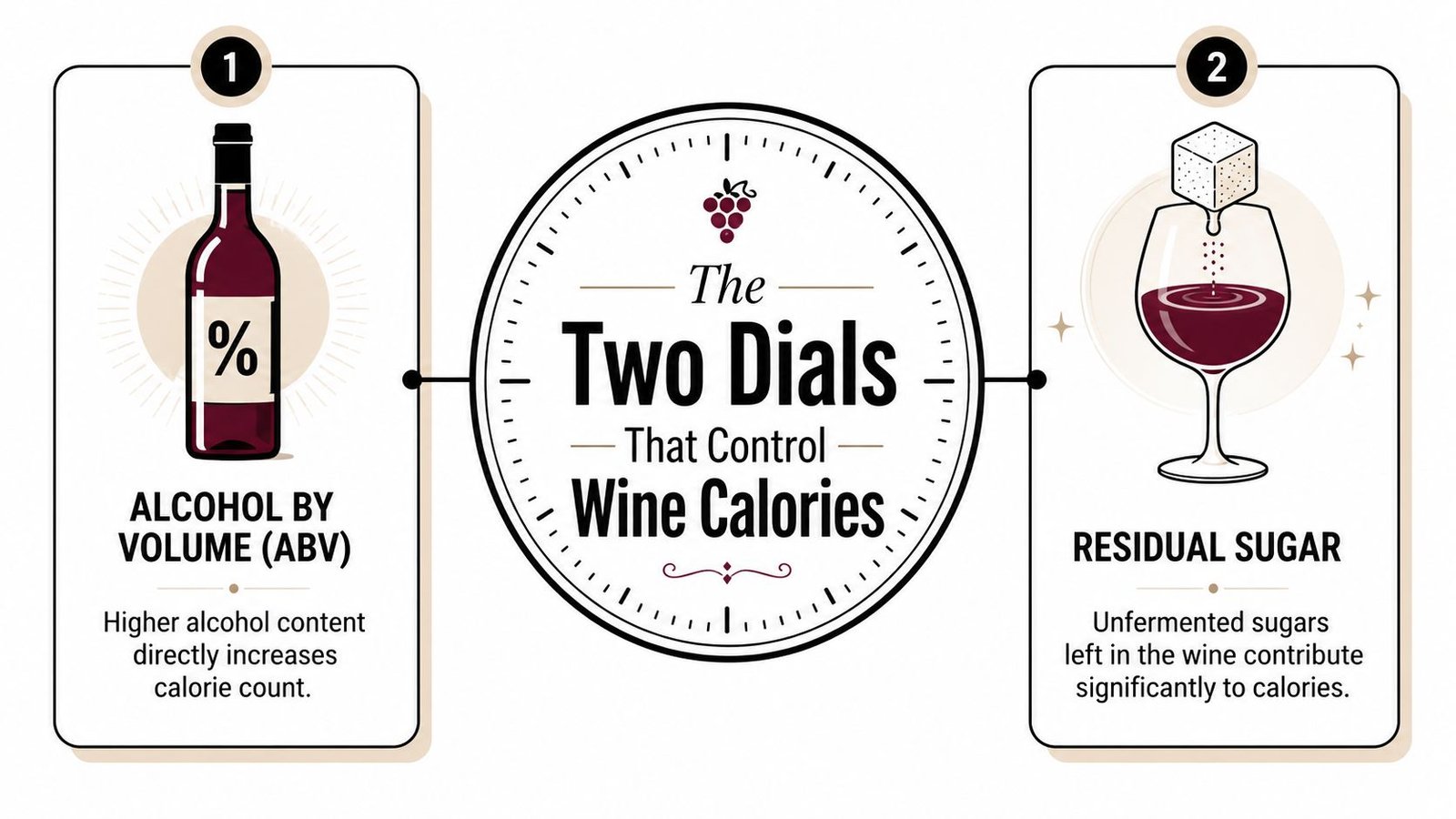
Dial one is alcohol
Alcohol is the bigger driver. It contributes about 7 calories per gram, which is why lower-ABV wine is usually lower in calories. According to The Barrel Tap's guide to wines with the least calories, low-calorie wines are typically around 92 to 120 calories per 5 oz glass, while 13 to 15% ABV wines can move into roughly 150+ calories depending on sugar.
That's why two dry wines can still have noticeably different calorie counts. If one is lighter in alcohol and the other is richer and boozier, the richer one usually costs more calories even if neither tastes sweet.
Dial two is residual sugar
Residual sugar is the sugar left behind in the wine after fermentation. Dry wines have less of it. Sweeter wines have more. That extra sugar adds carbohydrate calories on top of the alcohol calories.
If sugar in alcohol still feels confusing, this plain-English guide on how much sugar is in alcohol helps connect the label language to what's in the glass.
Practical rule: When you want the lowest calorie wine, look first for a lower ABV, then check whether the style is dry.
Why names can mislead you
A lot of shoppers assume grape variety tells the whole story. It doesn't. “Sauvignon Blanc” or “Pinot Grigio” can point you in a helpful direction, but style matters more than the grape name alone.
Use this simple filter when you're standing in a store:
- Look for dry styles instead of sweet ones.
- Check ABV if it's listed.
- Treat “light” as a clue, not proof.
- Remember that sparkling can be a strong option, especially in drier styles.
That's the framework that keeps you from getting distracted by branding. A wine can sound clean, natural, or wellness-friendly and still not be your lowest-calorie choice.
Your Guide to the Lowest Calorie Wine Styles
You're standing in front of a wine list and trying to keep calories in check. Three labels can look equally “light” at first glance: non-alcoholic wine, a bottle marketed as light, and a standard dry white. They do not solve the same problem.
That distinction matters because “lowest calorie wine” can mean three different things in real life. You might want the absolute fewest calories possible. You might want some alcohol, but less of it. Or you might want a normal wine experience and want to avoid the highest-calorie styles. Those are different goals, so it helps to sort wines into separate lanes instead of lumping them into one wellness category.
Non-alcoholic wine has the lowest calorie floor
If your top priority is cutting calories as far as possible, non-alcoholic wine usually sits at the bottom of the range. MyFoodData's wine calorie breakdown lists some non-alcoholic wine options at about 9 calories per glass.
That makes this category a clear fit for someone who wants the ritual of wine without much calorie impact, or who wants to skip alcohol altogether.
The trade-off is satisfaction. For some drinkers, non-alcoholic wine scratches the itch. For others, it feels more like a stand-in than a true substitute.
Light wine lowers calories by lowering alcohol
The next lane is light wine, usually made with lower alcohol by volume. MyFoodData lists a light wine at 6.5% ABV at about 73 calories per glass.
A dimmer switch works as a useful comparison here. Lowering ABV often lowers calories because alcohol is one of the main calorie drivers. But lowering that dial can also change body, warmth, and how “complete” the wine feels on the palate.
That is why a light wine can look great on paper but still disappoint some drinkers. If the glass feels less satisfying, it may lead to a refill or a larger pour later. For anyone tracking intake closely, that practical trade-off matters as much as the number itself. People using appetite-focused medications may notice that alcohol tolerance and drinking habits shift too, which is worth keeping in mind alongside these expert insights on GLP-1 and alcohol.
Standard dry wines are often the best mainstream compromise
For many shoppers and restaurant diners, the most realistic low-calorie choice is not non-alcoholic wine and not a specialty light bottle. It is a standard dry wine with moderate alcohol and little residual sugar.
This is usually the category that balances calories, taste, and convenience best.
Common examples include:
- Brut sparkling wine
- Extra brut sparkling wine
- Dry white wines such as Pinot Grigio and Sauvignon Blanc
These styles are often lighter than richer, higher-alcohol, sweeter wines, while still tasting like regular wine in the way many drinkers expect. If you want a practical restaurant order, this group is usually the easiest place to start.
A simple comparison table
| Wine Type | What it usually offers | Calorie direction |
|---|---|---|
| Non-alcoholic wine | Wine flavor with little or no alcohol | Lowest overall |
| Light wine | Lower ABV, often lighter body | Lower than standard wine |
| Brut or extra brut sparkling | Dry style, often crisp and lean | Often among the lighter standard options |
| Dry white wine | Familiar, easy-to-find restaurant choice | Often a moderate-calorie standard option |
| Sweet or higher-ABV wine | More sugar, more alcohol, or both | Usually higher |
Which category should you choose?
Use your goal as the tiebreaker.
Choose non-alcoholic wine if your goal is the absolute minimum. Choose light wine if you want alcohol but are willing to trade some body for fewer calories. Choose a standard dry sparkling or dry white if you want the easiest balance between calorie awareness and a classic wine experience.
If you eat out often, it also helps to pair your wine choice with a quick method for estimating calories when dining out, since the drink is only one part of the total meal.
Safe default orders
If you want a reliable starting point at a bar or restaurant, these are usually sensible picks:
- Brut sparkling for a dry, crisp option
- Sauvignon Blanc for a bright, lean white
- Pinot Grigio for a familiar lighter-style choice
None of these are magic calorie savers. They are styles that often make the trade-off easier: lower sugar, moderate alcohol, and a taste profile that still feels like wine rather than a compromise.
How to Make Smarter Choices at the Store and Bar
The most misleading part of low-calorie wine advice is this: people focus on the bottle and forget the pour.
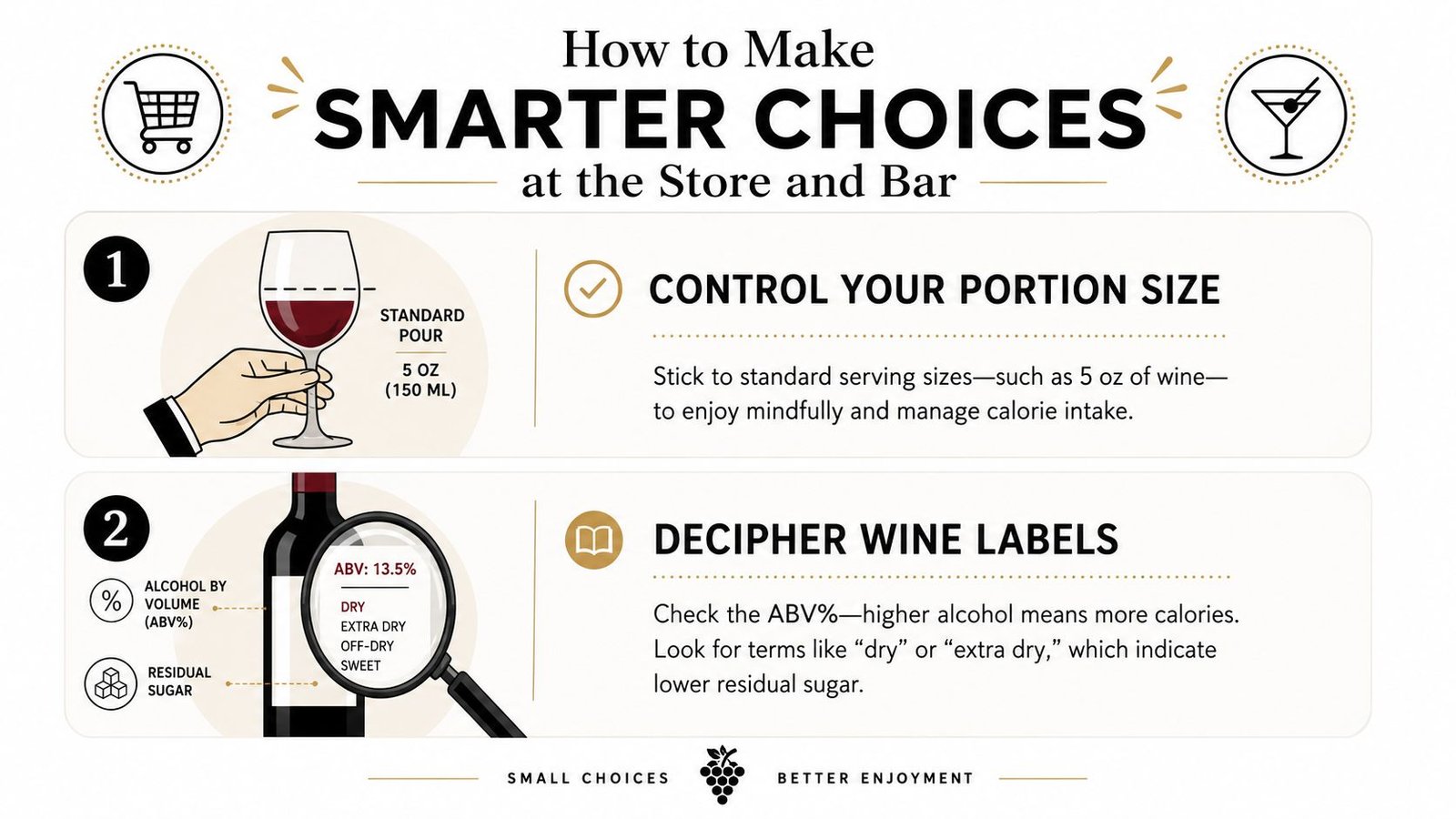
A wine can be low-calorie on paper and still become a high-calorie choice in practice if the glass is generous. Wine Folly notes that a 5 oz pour of low-calorie wine is 92 to 120 calories, but a 6 oz pour jumps to 110 to 144 calories, as explained in Wine Folly's guide to low-calorie wine. That's why portion size can matter more than the label.
Portion size changes the math fast
At home, many people don't pour 5 oz. They pour to the widest part of the glass or just “a normal amount.” At restaurants, pours can also feel larger than expected.
If you're trying to keep wine aligned with your calorie target, do this instead:
- Use the standard pour as your anchor. The numbers you see in guides usually assume 5 oz.
- Order one glass first instead of a bottle if you tend to lose track.
- Don't top off casually. Two small top-offs can add up to another serving.
- Estimate the whole meal, not just the entrée. This guide on how to estimate calories when eating out is useful when wine is only one part of the restaurant math.
Lower calorie can also mean lower alcohol
There's another trade-off that doesn't get enough attention. The lowest-calorie alcoholic wines are often also the lowest-ABV wines, often in the 7 to 9% ABV range, as noted by Wine Folly in the source above.
That can be great if you want a lighter drinking experience. But if you know you're likely to keep sipping until you feel a certain effect, the “lightest” wine may not always be the most helpful choice for you.
Sometimes the better choice isn't the lowest-calorie glass. It's the glass that helps you stop at one.
If you're navigating appetite changes, medication, or changing alcohol tolerance, these expert insights on GLP-1 and alcohol can add useful context.
Here's a quick visual refresher before your next order.
Log Your Wine in Seconds with PlateBird
Tracking wine is often more annoying than choosing it. Food apps usually make drinks feel harder than they should. You search “white wine,” get a cluttered list, then guess at ounces and hope the entry is close enough.
That friction is exactly why many people stop logging drinks consistently.
The old way versus the easy way
The old way is manual lookup. You dig through database entries, compare serving sizes, and try to remember whether your pour was closer to one glass or one and a half.
The easier option is using an AI-based tracker that handles plain language and photos. With PlateBird's AI calorie counter, you can type something simple like “glass of sauv blanc” or log from a quick image instead of hunting through endless entries.

Why consistency matters more than perfect precision
A sommelier-level nutrition database is not generally required. What is needed is a fast way to stay honest. If logging a drink takes too long, it usually doesn't happen.
A simple routine works better:
- Log the wine when you pour it
- Use the style name if you know it
- Keep the serving size realistic
- Stay consistent rather than chasing perfect detail
That approach gives you a much clearer picture of your intake over time, especially if wine is a regular part of your week.
Frequently Asked Questions About Low Calorie Wine
Is white wine always lower in calories than red wine
White wine is not automatically the lower-calorie choice. Color tells you less than many shoppers assume.
A better shortcut is to check two things first: ABV and sweetness. A dry white can be lighter than a rich red, but a high-alcohol white can also outpace a lower-alcohol red. If you remember those two dials, the label starts making more sense.
Pour size matters too. A modest glass of red and a generous pour of white are not close cousins in calories. They are different portions, and portion size often changes the total more than the grape does.
Does organic wine mean low-calorie wine
Organic wine and low-calorie wine are separate ideas.
Organic refers to how grapes are grown or how the wine is made. Calories come mostly from alcohol and, to a lesser extent, residual sugar. So an organic bottle can still be full-strength, sweet, and fairly calorie-dense.
This is one place where shoppers get tripped up. Health-focused words on the label can sound like nutrition clues, but they do not tell you much about the calorie count. For that, you still want to look at style, sweetness, ABV, and how much ends up in the glass.
What does brut mean if I want the lowest calorie wine
Brut usually means a dry sparkling wine with very little residual sugar. That is why it often lands near the lower-calorie end of standard alcoholic wines.
It helps to separate three categories that often get lumped together. Non-alcoholic wine is usually the lowest in calories because most of the alcohol has been removed. Light wine is lower in alcohol than standard wine, so calories often drop with it, though some people find it less satisfying. Brut sparkling and other dry standard wines still contain regular alcohol, but they can be a smart middle ground if you want a real glass of wine without choosing one of the heavier styles.
At a restaurant, brut is a practical order because it is easier to identify than many "light" labels. Just keep the pour in mind. Two small glasses can fit your plan better than one oversized one.
If you want to enjoy wine without turning every glass into a math problem, PlateBird makes tracking simple. Type what you drank, snap a photo, and keep your calorie and macro log moving without the usual friction.