You walk into the gym planning to do “some cardio,” then stop between two rows of machines. On one side, treadmills with people cruising at an easy pace or grinding up steep inclines. On the other, ellipticals with that smooth gliding motion that looks easier until you try to hold a hard pace for more than a few minutes.
That moment matters more than is often acknowledged. The walking vs elliptical machine decision isn't really about which machine wins. It's about which tool matches your body, your current limitations, and the result you want.
I've seen people pick the wrong option for months only because they followed a generic rule. The person with cranky knees forces long treadmill sessions because they think walking is more “real.” The person who wants stronger bones avoids walking because the elliptical feels nicer. The person chasing fat loss picks the machine that burns more calories on paper, then quits after two weeks because they hate it.
A better way to decide is to start with the goal, then choose the machine that best serves it. That's how this guide approaches walking vs elliptical machine choices. Not as a popularity contest, but as a practical framework you can use the next time you step onto the gym floor.
The Cardio Crossroads Deciding Your Path
Individuals don't need more cardio information. They need a clearer filter.
When clients ask me whether walking or the elliptical is better, my first response is usually another question: better for what? Weight loss? Joint comfort? Conditioning? Bone health? Training consistency? Those answers change the recommendation fast.
Here's the short version early, because it helps to orient the rest of the discussion.
| Attribute | Walking | Elliptical |
|---|---|---|
| Movement pattern | Natural, simple, familiar | Guided, gliding, lower impact |
| Calories | Can be modest or high with speed and incline | Often higher per minute at steady effort |
| Joint feel | Weight-bearing with repeated foot strike | Lower joint stress because feet stay on pedals |
| Muscle emphasis | Strong carryover to daily life and outdoor activity | More quad-heavy, especially with active resistance |
| Bone health | Better fit if bone-loading matters | Less impact, so less useful for that specific goal |
| Beginner friendliness | Very accessible | Also beginner-friendly, especially if joints are sensitive |
| Workout variety | Speed, incline, long steady sessions, intervals | Resistance, cadence, reverse motion, handle use |
That table gives you the map. The primary decision comes from matching the map to your main objective.
Practical rule: If you can't name your primary goal in one sentence, you'll probably bounce between machines without progressing on either one.
A lot of the confusion comes from lumping all cardio together. People say “it's all just cardio” as if the body responds the same way to every machine. It doesn't. Walking and elliptical sessions can both improve fitness, but they load the body differently, stress the joints differently, and fit different recovery profiles.
The useful question isn't which one is universally superior. It's which one gives you the best return for the next phase of your training.
Calorie Burn and Weight Loss Potential
If your main goal is fat loss, most comparisons start there. Fair enough. Energy expenditure matters.
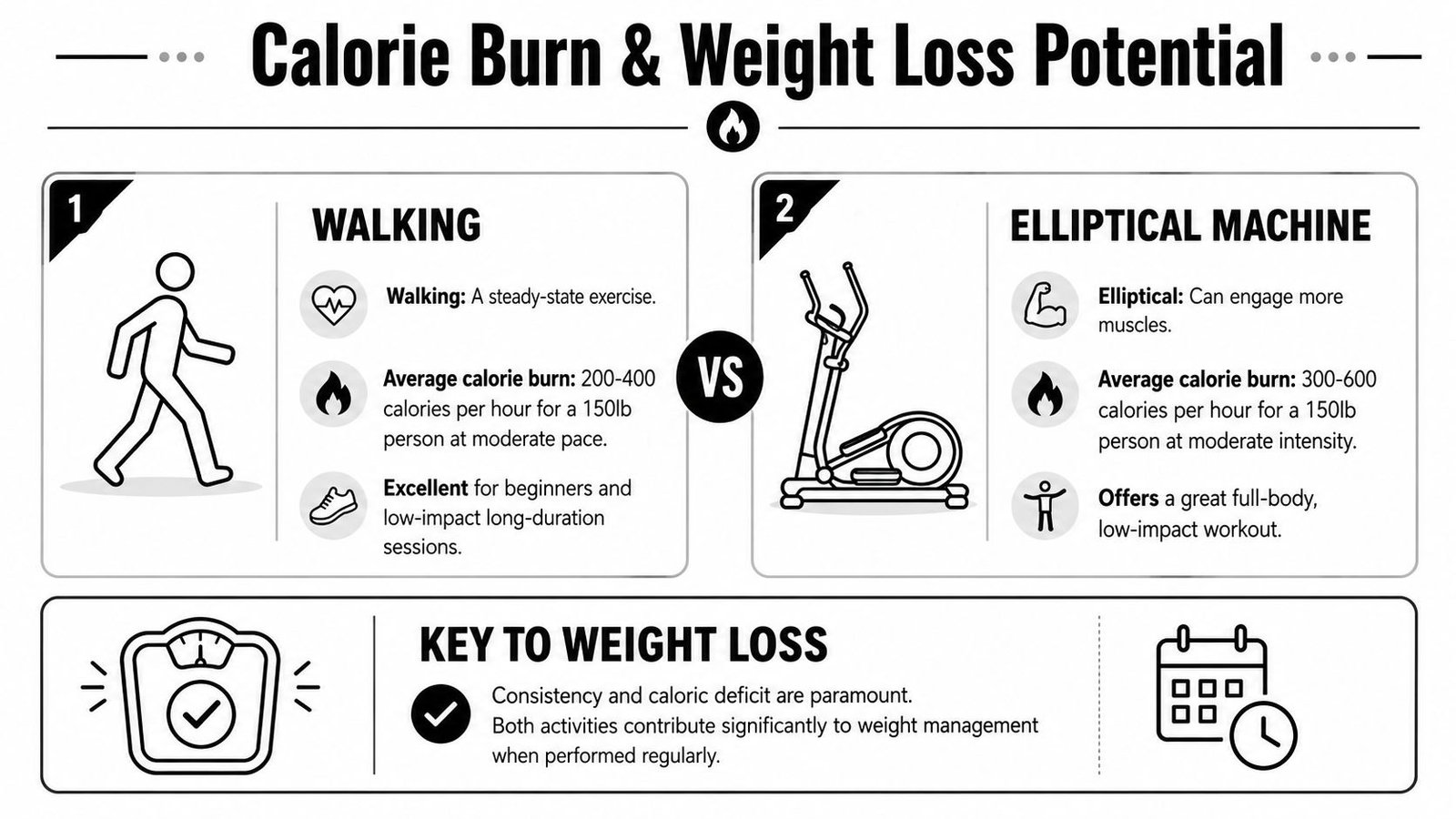
The strongest consumer estimate in the available data shows that a 155-pound person burns about 324 calories in 30 minutes on an elliptical versus about 133 calories in 30 minutes of walking according to Lose It's walking versus elliptical comparison. That gap explains why many people feel the elliptical gives them more “bang for the buck” when time is tight.
Why the elliptical often wins on paper
The elliptical usually keeps you in continuous motion. There's less coasting, less natural slowdown, and often more total-body involvement if you use the moving handles properly. For many people, that makes it easier to accumulate a higher workload without the joint irritation that sometimes limits longer walking sessions.
That said, calorie numbers don't decide results by themselves. A hard treadmill walk with incline can become a serious workout. A lazy elliptical session where you let the machine carry the rhythm can turn into expensive standing.
The machine doesn't create the calorie deficit. Your repeated training effort and food intake do.
That's why I don't like “best for weight loss” answers without context. The better question is which option helps you sustain the highest useful workload consistently across the week.
What works in real life
For busy people, the elliptical often fits better because it can feel smoother while still being demanding. For deconditioned beginners, walking often wins because it feels familiar and less intimidating. For some, that familiarity is the difference between training regularly and skipping sessions.
A simple way to view it:
- Choose the elliptical if you want higher output in less time and your joints prefer low-impact movement.
- Choose walking if you'll do it more often, for longer, or with enough incline to make it challenging.
- Use both if boredom kills consistency. Rotation beats perfection.
If weight loss is your primary target, cardio works best when it's paired with a structured nutrition plan. Some people do well with self-tracking. Others benefit from clinical support like Pause Medical weight loss when they need more accountability around energy balance, appetite, and routine.
If you like comparing everyday activity to formal cardio, this breakdown of calories burned mowing the lawn is a useful reminder that movement adds up, but planned exercise still gives you more control over intensity.
The mistake people make
They chase the biggest calorie number, then pick a workout they don't recover from well or don't enjoy.
For fat loss, the best machine is usually the one you can repeat without dread, while still progressing either duration, intensity, or frequency. High burn is helpful. Sustainability is what makes it matter.
Muscle Engagement and Full Body Activation
People often treat cardio as if muscles are just along for the ride. They aren't. The pattern of muscle recruitment changes the feel of the workout and the kind of fatigue you get after it.
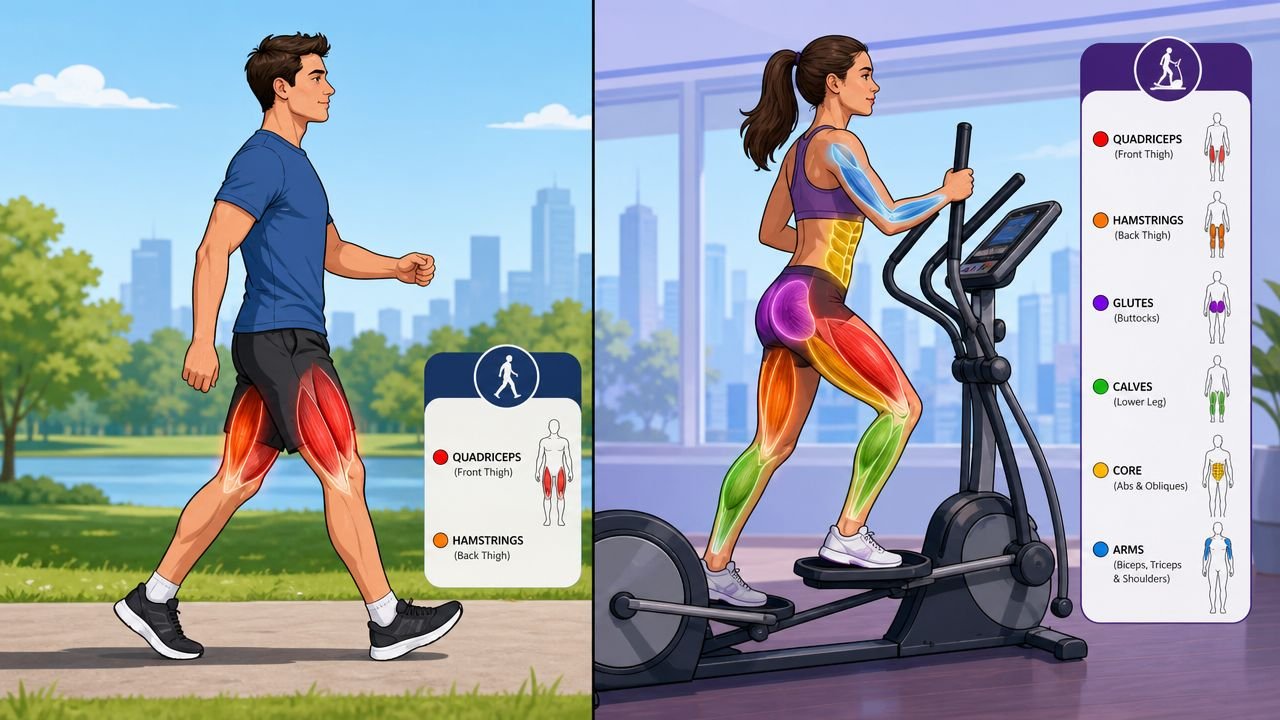
A key study found that elliptical training produced greater quadriceps activity and greater quadriceps and hamstrings coactivation than treadmill walking, according to the exercise-comparison research archived at PubMed Central. That matters because it moves the conversation beyond “which one feels harder.” The elliptical can create a more demanding leg challenge in specific ways even while feeling smoother and lower impact.
What that means for your legs
Walking is still excellent lower-body work. It's a natural gait pattern, easy to repeat, and especially useful if your goals include daily function, outdoor fitness, or event prep like charity walks and hiking. If you're curious about the visual and muscular side of that, this guide on how walking affects leg muscles gives a practical consumer-level explanation.
The elliptical shifts the load differently. In practice, many people feel that in the front of the thighs sooner than they do during standard walking. Add resistance, stay honest with cadence, and keep your hips stable, and the machine turns into more than “easy cardio.”
A quick coaching note. If you death-grip the handles and let your body bounce around, you lose much of the training benefit.
When people say full body
They're usually talking about the moving handles.
If you actively push and pull those handles instead of letting your arms drift, the elliptical can involve the upper body in a way walking usually doesn't. It won't replace a proper strength session for your chest, back, shoulders, or arms, but it can spread work across more tissue in a single cardio session.
For readers balancing body composition goals, this deeper look at burn fat and build muscle helps connect cardio choices with the larger training picture.
A useful visual demo can help you clean up your setup and arm action before you default to momentum:
Which one is better for toning
“Toning” usually means one of two things. Building some muscle, or losing enough body fat to see the muscle you already have.
For the first piece, the elliptical has a clear argument if you want more quad demand during cardio. For the second piece, either machine can help, assuming your nutrition and total training load support the goal.
Don't expect either machine to sculpt your body by itself. Use them to support energy expenditure, work capacity, and consistency.
If you want movement that feels more natural, walking wins. If you want cardio that can challenge the legs more aggressively while staying joint-friendly, the elliptical has the edge.
Joint Impact and Long Term Bone Health
The walking vs elliptical machine debate becomes more nuanced.
If your knees, hips, or ankles get irritated easily, the elliptical often feels better immediately. That's not just preference. The movement removes the repeated foot strike you get during walking. Cleveland Clinic notes that walking can help build bone density because the impact stimulates bone growth, while ellipticals reduce joint pressure and are often recommended after injury or for those with joint conditions, as explained in its guide on treadmill versus elliptical decisions.
When low impact is the right choice
If you're rehabbing, managing arthritis, or trying to stay active without flaring symptoms, the elliptical is often the better tool. It lets many people train longer with less discomfort. That matters because the perfect program on paper isn't useful if your joints hate it.
I've seen this especially with people who want to “push through” knee irritation on a treadmill because walking feels more honest to them. Usually, that stubbornness just reduces total weekly training volume. Switching to the elliptical often lets them keep cardio in the plan instead of dropping it.
When impact is actually useful
Low impact isn't automatically better.
If bone health is one of your priorities, walking has a meaningful advantage because it's weight-bearing and includes impact. That loading stimulus is part of why walking remains valuable even when another machine feels smoother. This is the trade-off many people miss. The more comfortable option for your joints may not be the better option for your bones.
Here's the practical split:
- Use walking more often if your body tolerates it well and bone-loading matters.
- Use the elliptical more often if pain reduction is what keeps you moving consistently.
- Combine them if you want both comfort and some regular weight-bearing work.
Your body doesn't award points for choosing the tougher option. It rewards the option you can recover from and repeat.
For older adults, post-injury exercisers, and anyone with chronic joint irritation, this section should carry a lot of weight in the decision. Comfort matters. So does the kind of mechanical stress your body still needs.
Programming Intensity and Workout Variety
A lot of people compare machines when they should be comparing workloads.
The best available evidence here is straightforward. A 2010 study summarized by Healthline found that when oxygen consumption, heart rate, and calories burned were matched, the elliptical and treadmill were nearly identical, which supports the idea that the elliptical is an acceptable alternative for cardiovascular training. Healthline's summary of that finding is in its article on elliptical versus treadmill cardio.
That means your results depend less on the label on the machine and more on how you program the session.
Three ways to make walking harder
Walking gets underestimated because people only think of casual flat walking.
Use these levers instead:
Increase incline
Incline changes the workout quickly. Even moderate speed can become demanding when the grade rises.Manipulate pace
Alternate comfortable walking with brisk intervals. That's easier to sustain mentally than trying to hold one hard pace from start to finish.Extend duration
Longer steady sessions work well for beginners, recovery days, or anyone building an aerobic base.
A simple progression could look like this:
- Beginner: easy steady walk at a pace where conversation is still possible
- Intermediate: alternating blocks of brisk walking and easier recovery
- Advanced: incline intervals with short recovery periods
Three ways to make the elliptical count
The elliptical has its own progression tools:
- Resistance: more muscular demand, especially through the legs
- Cadence: a higher turnover raises effort fast
- Direction changes: pedaling backward can shift the feel of the effort and break monotony
People often waste elliptical sessions by moving too fast against too little resistance. That turns the workout into a rhythm drill more than a training session. A better setup is moderate resistance first, then enough cadence to challenge your breathing without losing posture.
Sample formats that work
Try one of these depending on your level:
| Level | Walking session | Elliptical session |
|---|---|---|
| Beginner | Steady comfortable walk | Steady easy glide with light resistance |
| Intermediate | Brisk intervals plus recovery walking | Alternating moderate and harder resistance blocks |
| Advanced | High-incline intervals | Hard cadence pushes against meaningful resistance |
If you're bored easily, rotate formats by day. One steady session. One interval session. One longer easy day. Variety helps adherence, and adherence is still the true driver.
Your Goal Based Framework for Choosing
Readers often don't need more pros and cons. They need a decision.
Walking vs Elliptical at a Glance
| Attribute | Walking | Elliptical |
|---|---|---|
| Best for natural movement | Excellent | Good, but guided path |
| Best for joint sensitivity | Fair to good, depends on tolerance | Excellent |
| Best for bone-loading | Better choice | Less ideal |
| Best for higher output in less time | Can work with incline | Often easier to achieve |
| Best for quad-focused cardio feel | Moderate | Stronger fit |
| Best for outdoor carryover | Excellent | Limited |
| Best for full-session variety indoors | Good | Very good |
If your main goal is weight loss
Pick the machine you can push consistently and recover from.
For some people, that will be the elliptical because it lets them work hard without getting beaten up. For others, it will be treadmill walking because they enjoy it, can stay on longer, and can progress incline over time. If you're honest about effort, both can contribute. If you're choosing strictly on time efficiency, the elliptical often makes sense.
If your main goal is protecting sensitive joints
Choose the elliptical first.
This is the easiest recommendation in the whole comparison. If impact annoys your joints, the lower-impact gliding motion is usually the better fit. You can still train hard. You just reduce one common source of aggravation.
If your main goal is bone health
Choose walking first.
If your body tolerates it, the weight-bearing and impact component make walking the stronger option for this specific goal. That doesn't make the elliptical bad. It just means it's not the lead tool when bone-loading is part of the mission.
If your main goal is a more leg-intensive cardio session
Lean toward the elliptical.
The quad demand and lower-body coordination demands are a real differentiator. This is especially useful for people who want their cardio to feel more like muscular work rather than just steady locomotion.
If your main goal is training for real-life movement
Choose walking.
Walking carries over directly to hiking, travel, errands, long days on your feet, and outdoor events. There's no learning curve because it's the movement you already use in daily life.
If your main goal is consistency
Pick the one you don't resist.
That sounds obvious, but it's where people sabotage themselves. The best cardio tool is the one that fits your schedule, your joints, and your willingness to repeat it next week.
A good program doesn't ask one machine to do everything. It picks the right machine for the current goal.
If you're still torn, don't force a permanent choice. Use walking on days you want simplicity and bone-loading. Use the elliptical on days you want lower impact or a smoother hard effort. That's often the most practical answer.
Tracking Your Progress and Staying Motivated
Choosing between walking and the elliptical is step one. Sticking with the choice long enough to see change is a significant challenge.
Individuals often lose momentum because they rely on memory and mood. They guess how long they worked, how hard the session felt, and whether their food intake “wasn't that bad.” That usually leads to stalled progress and a lot of confusion.
What to track each week
Keep it simple. You don't need a giant spreadsheet.
Track a few basics:
- Session duration: how long you trained
- Machine setting: incline for walking, resistance for elliptical
- Effort level: easy, moderate, or hard
- Frequency: how many sessions you completed
- Recovery notes: whether joints felt fine, stiff, or irritated
If you wear a tracker, comfort matters because uncomfortable gear gets left on the charger. For people who want a more wearable setup, comfortable Fitbit Luxe bands can make daily tracking easier to stick with.
Motivation gets easier when the feedback loop is tight
You need to connect training behavior to outcomes you can see. That might be improved stamina, fewer skipped workouts, easier recovery, or more stable body weight trends.
Nutrition is usually the missing half. If fat loss is the goal, your workout choice matters, but your food intake still controls whether the effort turns into progress. A practical system like a food diary for weight loss can help people stop relying on vague recall and start seeing patterns clearly.

The standard that keeps people progressing
Don't ask, “Which machine is best?” every week.
Ask better questions:
- Did I complete the planned sessions?
- Did I increase workload gradually?
- Did my joints tolerate the plan?
- Did my eating match the goal?
That approach removes emotion from the process. Whether you choose walking, the elliptical, or a mix of both, progress usually comes from boring consistency done well.
If you want the nutrition side to feel as easy as the cardio decision, PlateBird helps remove the friction. You can log meals by typing what you ate or snapping a photo, which makes it much easier to connect your walking or elliptical sessions to your actual calorie and macro intake.