
You've probably seen calorie advice that sounds oddly precise and completely disconnected from real life. One app says eat 1,200 calories. A trainer says 1,800. A friend swears 2,000 is the magic number. Meanwhile, you're standing in your kitchen trying to figure out whether your lunch was “healthy enough” and why none of these numbers seem to fit you.
That confusion makes sense. A calorie target only works when it belongs to your body and your routine. The good news is that how to calculate daily calories isn't mysterious once you break it into a few simple steps. The even better news is that the first number you get isn't the finish line. It's your starting estimate.
Why a Universal Calorie Count Never Works
Two people can eat the same meals, train at the same gym, and still need very different calorie intakes.
A taller person usually needs more energy than a shorter person. A younger person and an older person won't always burn energy at the same rate. A person who spends most of the day at a desk has different needs than someone who walks, lifts, chases kids, or works on their feet. That's before you even factor in sex, body size, or how active your weeks really are.
Why generic plans feel so frustrating
A one-size-fits-all number sounds convenient, but it skips the details that matter. It treats your body like an average. You don't live like an average.
That's why so many people feel like they're “failing” a calorie plan when the actual problem is that the plan was borrowed from someone else. The math may have been clean, but it wasn't personal.
Practical rule: A calorie target should feel like a tailored starting point, not a rule pulled from a random social post.
Your body has its own energy fingerprint
Think of calories like a fuel budget. Your body has fixed costs, like breathing and circulation, plus variable costs, like walking, lifting, chores, errands, and workouts. The total changes from person to person.
That's also why simple body-size tools can only tell part of the story. If you've ever wondered why body weight alone doesn't explain your needs, this guide on BMI for athletes and body composition differences helps show why broad labels often miss what's going on.
Here's the mindset shift that makes calorie tracking less intimidating:
- Your first number is personal. It's based on your age, height, weight, sex, and activity.
- Your first number is also imperfect. It's an estimate, not a verdict.
- Your real target comes from testing it. That's where most guides stop too early.
Once you understand that, the process gets calmer. You're not searching for a magical calorie number. You're calculating a smart baseline and then adjusting it based on what your body does in real life.
Finding Your Baseline with the BMR Formula
The first number to learn is BMR, or Basal Metabolic Rate. That's the amount of energy your body uses at complete rest to handle basic life functions like breathing and circulation.
The most widely used modern formula for this is the Mifflin-St Jeor equation, published in 1990, which remains the most accurate formula for estimating BMR compared to older models like Harris-Benedict, according to NASM's calorie calculator reference.
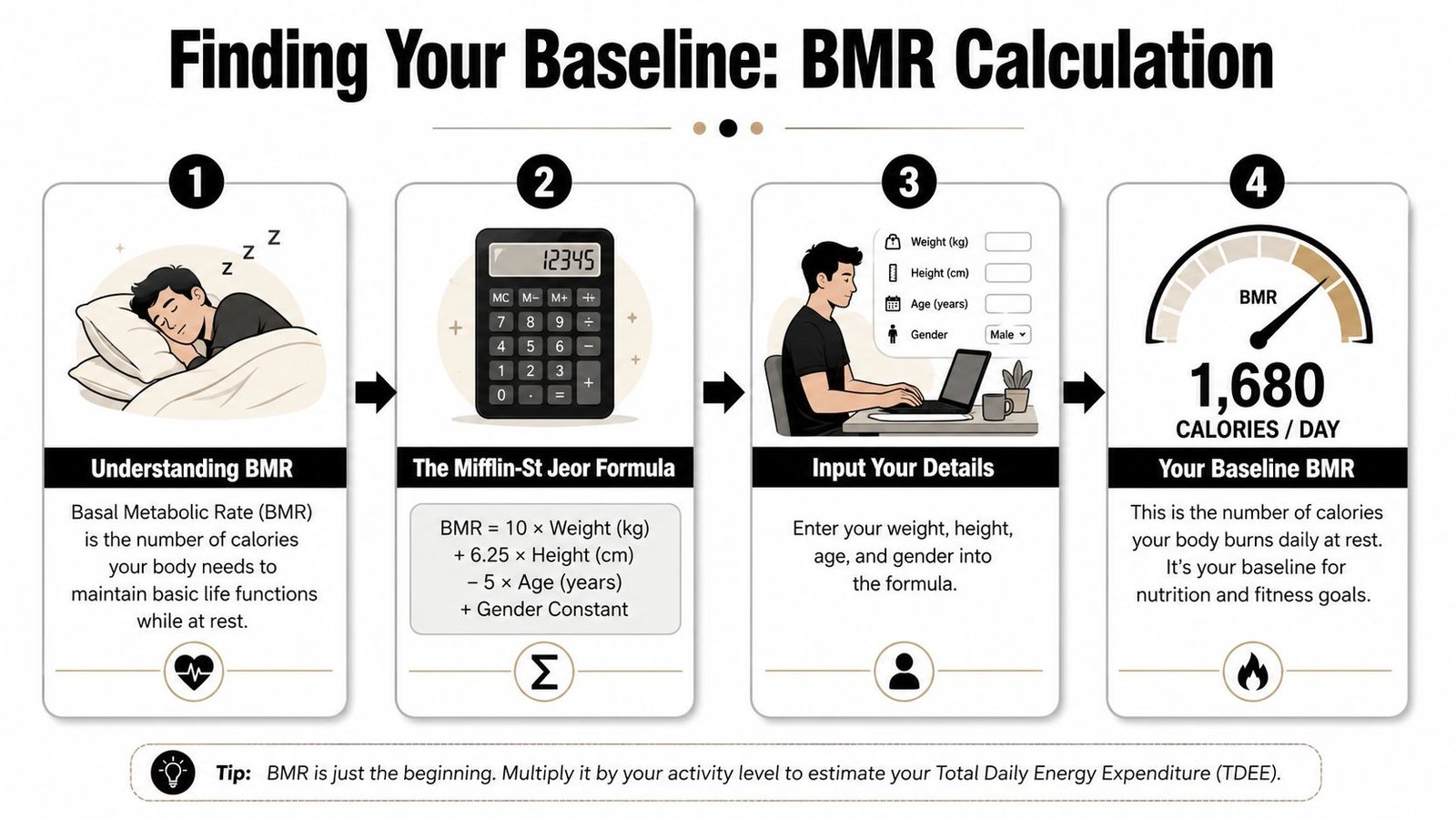
The formula
For men:
(10 × weight in kg) + (6.25 × height in cm) – (5 × age in years) + 5
For women:
(10 × weight in kg) + (6.25 × height in cm) – (5 × age in years) – 161
The idea is simple. Your body size affects how much energy you burn. Height and weight help estimate that size. Age is included because energy needs shift over time. The final constant differs for men and women.
A worked example for a man
Let's say a man is:
- Weight: 80 kg
- Height: 180 cm
- Age: 30
Plug those numbers in:
- 10 × 80 = 800
- 6.25 × 180 = 1125
- 5 × 30 = 150
Now assemble the formula:
800 + 1125 – 150 + 5 = 1780
His estimated BMR is 1780 calories per day.
That means if he did nothing but rest all day, his body would still need that much energy to keep the lights on.
A worked example for a woman
Now let's use:
- Weight: 65 kg
- Height: 165 cm
- Age: 30
Plug those in:
- 10 × 65 = 650
- 6.25 × 165 = 1031.25
- 5 × 30 = 150
Now assemble the formula:
650 + 1031.25 – 150 – 161 = 1370.25
Her estimated BMR is about 1370 calories per day.
Your BMR is not your eating target. It's your baseline. Most people need more than this because real life includes movement.
What readers usually get confused about
The math itself isn't the hard part. Unit conversion is usually where people get stuck.
If you know your height in inches or your weight in pounds, convert them first before using the formula. Then keep your calculator open and do it one line at a time. You don't need to be “good at math.” You just need to move slowly enough to avoid mixing up units.
A helpful way to think about BMR is this: it's your body's idle speed. A parked car still burns fuel while it's running. Your body does too.
Adjusting for Lifestyle to Find Your TDEE
BMR gives you resting needs. TDEE, or Total Daily Energy Expenditure, gives you a fuller estimate of what you burn in normal life.
You calculate it by multiplying your BMR by an activity factor. If you want a deeper explanation of the concept itself, this guide on what TDEE means in practice is a useful companion.
Activity level multipliers
Here are the standard multipliers used to estimate TDEE.
| Activity Level | Description | Multiplier |
|---|---|---|
| Sedentary | Little or no exercise | 1.2 |
| Lightly active | Exercise 1 to 3 days per week | 1.375 |
| Moderately active | Exercise 3 to 5 days per week | 1.55 |
| Very active | Exercise 6 to 7 days per week | 1.725 |
| Extra active | Hard training or very physical lifestyle | 1.9 |
These multipliers come from the calorie calculation method summarized by NASM in the earlier section.
Using the multiplier
Take the BMR examples from above.
For the man with a BMR of 1780, if he's moderately active:
1780 × 1.55 = 2759
His estimated maintenance intake is 2759 calories per day.
For the woman with a BMR of about 1370, if she's lightly active:
1370.25 × 1.375 = 1884.09
Her estimated maintenance intake is about 1884 calories per day.
That maintenance estimate is your TDEE. It's the number that's meant to reflect rest plus everyday activity.
The most common mistake
Individuals don't underestimate workouts. They overestimate lifestyle activity.
Someone may train a few times per week but spend the rest of the day sitting. Another person may never do formal workouts but walk constantly, take stairs, and stay on their feet for hours. Those patterns matter.
A major issue with static activity multipliers is that they can miss the messiness of real life. Self-reported activity levels are often misclassified by 15–25%, as noted in this discussion of variable activity and TDEE estimation on YouTube.
Choose the multiplier based on your full week, not your best workout day.
A simple honesty check
If you're unsure which category fits, ask yourself:
- Most of my day is seated. Start lower.
- I train, but my non-gym hours are mostly inactive. Don't jump to “very active.”
- My job and daily routine keep me moving for long stretches. A higher multiplier may fit better.
- My weeks change a lot. Treat the result as a draft, not a final answer.
That last point matters more than people realize. TDEE calculators are helpful, but they're not measuring your body directly. They're estimating. That's why the next step is where the process becomes personal.
Setting Your Target Calories for Any Goal
You plug your numbers into a calculator and get a maintenance estimate. Then the obvious question hits. What should you eat tomorrow?
The answer depends on the job you want calories to do. Calories work like a budget. Maintenance is your break-even point. Eat below it and your body has to draw on stored energy. Eat around it and your weight is more likely to stay stable. Eat above it and you create extra fuel that can support muscle gain, although the surplus still needs to be controlled.
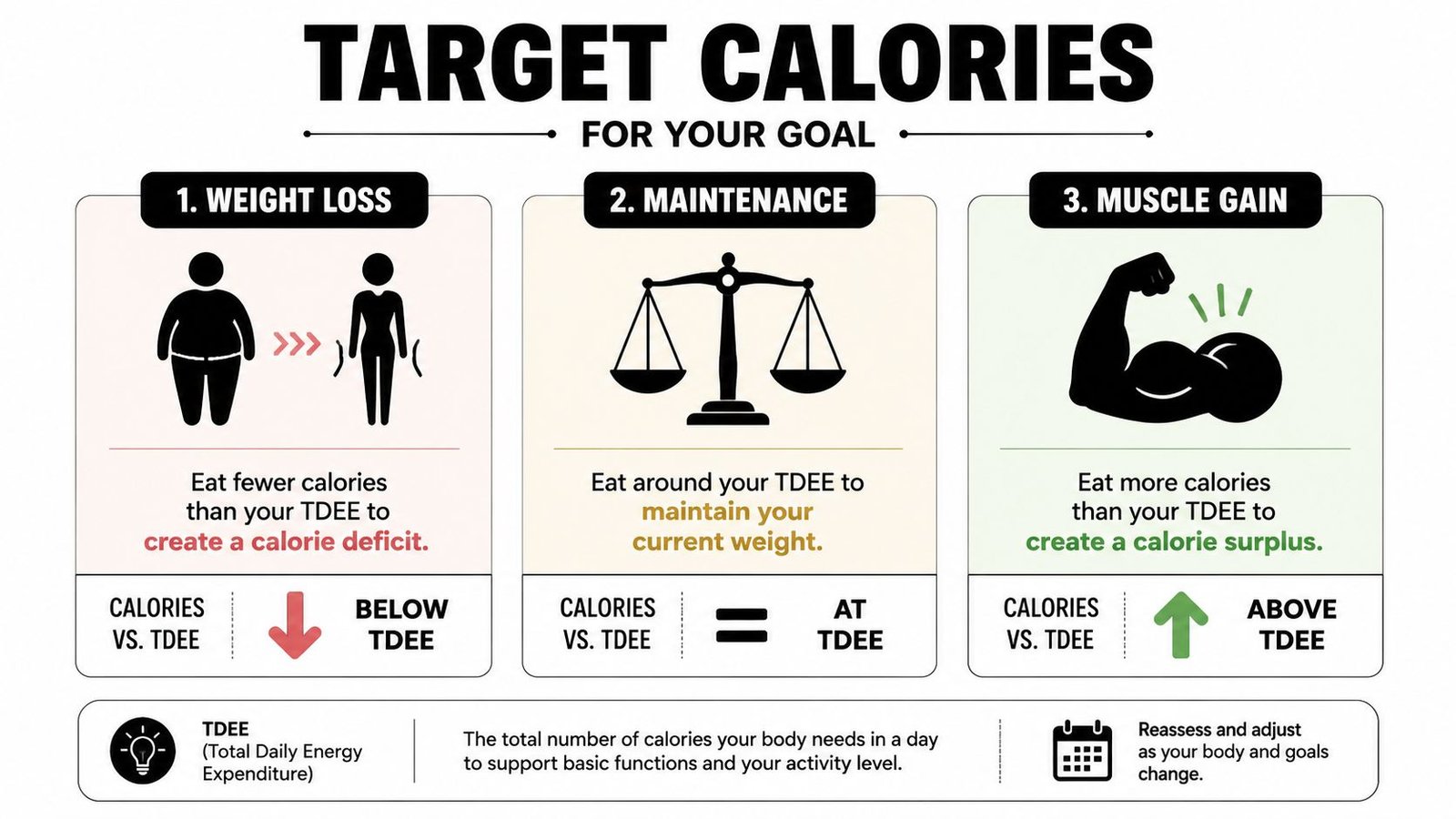
Just keep one idea front and center. Your calculated target is a starting estimate, not a verdict. It is a hypothesis you will test with the 14-Day Validation Protocol later, because real-life appetite, movement, stress, and tracking accuracy can shift the result.
Weight loss
For fat loss, start below maintenance by a moderate amount. A common rule of thumb, noted earlier from the NHS, is about 600 calories below maintenance for a steady rate of loss.
If your estimated TDEE is 2759, the math looks like this:
2759 – 600 = 2159 calories per day
That gives you a sensible first draft.
A moderate deficit usually works better than an aggressive one because it is easier to follow, easier to recover from, and less likely to turn into a cycle of strict weekdays and overeating on weekends. If you want habit ideas that make the numbers easier to live with, the Healtsy Magazine weight loss tips article gives practical examples.
Maintenance
Maintenance means eating close to your estimated TDEE and using that period to stabilize.
If your TDEE is 1884, your starting maintenance target is about 1884 calories per day.
This phase is useful for beginners who want to practice tracking, for people who are happy with their current weight, and for anyone who wants cleaner data before choosing a deficit or surplus. Maintenance is often treated like "doing nothing," but it is the phase where many people learn what normal intake looks like.
Muscle gain
For muscle gain, eat above maintenance, but keep the surplus small. More calories do not automatically mean more muscle. They can also mean faster fat gain.
If your TDEE is 1884, your gain target should start slightly above 1884. A conservative increase gives you room to watch how your body responds and adjust before the surplus gets too large.
That slower approach is usually less frustrating. It is like turning a dial instead of slamming a switch.
Maintenance is the reference point. Loss goes below it. Gain goes above it.
A simple sanity check
You can also compare your estimate to a rough rule of thumb mentioned earlier. For a moderately active person, 15 calories per pound of body weight can serve as a quick maintenance check.
For example, a 180-pound person would land around:
180 × 15 = 2700 calories per day
Use that as a comparison, not as your final answer. If your formula result and your rule-of-thumb result are fairly close, that is reassuring. If they are far apart, do not panic. Start with your calculated target, then let the 14-Day Validation Protocol show you what your real-world maintenance, loss, or gain calories are.
Translating Calories into Protein Carbs and Fats
Calories tell you how much to eat. Macros help guide what those calories are made of.
The three macronutrients are protein, carbohydrates, and fats. You don't need to become a nutrition scientist to use them well. You just need a practical structure that supports your goal and keeps meals satisfying.
Start with protein
If you're eating in a calorie deficit, protein deserves first priority. A key guideline is 1.6–2.2 g/kg of body weight to help prevent lean mass loss during caloric restriction, based on the technical recommendation cited in this protein intake reference.
If you weigh 65 kg, that range would be:
- 65 × 1.6 = 104 g
- 65 × 2.2 = 143 g
So a practical protein target would be 104 to 143 grams per day.
That gives you a strong anchor for building the rest of your day.
What about carbs and fats
After protein, carbs and fats can be adjusted based on preference, training style, and what helps you stay consistent. Some people like more carbs around workouts. Others prefer a bit more fat because meals feel more filling.
A simple beginner approach is:
- Set protein first
- Include carbs in meals where you want energy
- Use fats to round out meals and improve satisfaction
This doesn't have to be rigid. It just has to be repeatable.
A meal-building shortcut
If macro numbers feel abstract, build plates instead:
- Protein first: chicken, Greek yogurt, eggs, tofu, fish, lean beef
- Carb source next: rice, potatoes, oats, fruit, beans, pasta
- Fat source last: olive oil, avocado, nuts, seeds, cheese
That approach keeps the math connected to actual food.
If you need ideas that make higher protein intake easier without eating the same meal every day, this collection of delicious high-protein meals can help you turn a protein target into meals you'll want to repeat.
Food quality rule: Hit your calorie target, but don't ignore how those calories are distributed. Better meal structure usually makes consistency easier.
How to Validate and Effortlessly Track Your Intake
You calculate your calories, follow the number for a few days, and then the scale jumps up two pounds after a salty dinner. A beginner sees that and assumes the formula failed. In reality, your body is doing what bodies do. It holds more or less water, stores more or less food in the digestive system, and changes from day to day for reasons that have nothing to do with fat gain or fat loss.
That is why your first calorie target is a starting estimate, not a final answer.

The 14-Day Validation Protocol
A calorie formula works like a rough map. It points you in the right direction, but it does not tell you the exact speed of your metabolism, your weekend eating habits, or how active you really are between workouts. Your calculated TDEE is a hypothesis. The 14-day validation phase is how you test that hypothesis in real life.
Here is the goal. For two weeks, you keep your intake as steady as you reasonably can and compare that intake to your weight trend, not to any single weigh-in.
That last part matters. A single scale reading is like one frame of a movie. It can be true and still be misleading. The trend across 14 days gives you the fuller story.
How to run it
Days 1 to 3: Set the baseline and expect noise
- Eat as close as you can to your calculated maintenance calories
- Weigh yourself each morning after using the bathroom and before eating or drinking
- Log everything you eat, including oils, sauces, drinks, bites, and weekend extras
Do not try to interpret the first few days too quickly. Early fluctuations are common. A harder workout, a higher-carb meal, poor sleep, or a restaurant dinner can all shift scale weight without changing body fat in a meaningful way.
Days 4 to 10: Stay boring on purpose
This is the part many beginners skip, but it is the part that makes the result useful. Keep meals repetitive enough that your intake is easier to hit. You do not need a perfect meal plan. You need enough consistency that your body is responding to a clear signal.
If your calories swing wildly from day to day, the test becomes blurry. A steady intake gives you cleaner feedback, the same way a steady speed makes it easier to tell whether your car is climbing, descending, or staying level.
Days 11 to 14: Look for the direction, not the drama
By the second week, the trend becomes easier to read. Ask a simple question: is your average weight holding steady, drifting down, or drifting up?
- If your weight trend is roughly stable, your maintenance estimate is probably close
- If your weight trend is gradually rising, your true maintenance is likely lower than you calculated
- If your weight trend is gradually falling, your true maintenance is likely higher than you calculated
How to interpret the result on Day 14
Do not judge the protocol by your highest weigh-in or your lowest one. Compare your average from the first several days to your average from the last several days.
That gives you a calmer and more accurate read.
If the averages are close, keep your calories where they are. You found a practical maintenance target. If the second average is clearly higher, reduce calories modestly and repeat the process. If the second average is clearly lower, add calories modestly and repeat the process.
Small adjustments work better than dramatic ones. You are tuning the dial, not smashing the radio.
Why tracking usually falls apart
The math itself is rarely the problem. Friction is.
People start with good intentions, then get tired of searching for foods, estimating mixed meals, and entering every ingredient after a long workday. Consistency drops. Once tracking feels like paperwork, the validation phase breaks down because the inputs are no longer trustworthy.
That is why the best tracking method is the one you will still use on a busy Wednesday. For meals without labels or exact portions, a tool built for photo-based calorie estimation and easier meal logging can reduce the effort between eating and recording, which makes the 14-day test easier to complete.
A quick video makes that idea easier to see in action.
What success actually looks like
Success is not perfect tracking. Success is getting close enough, often enough, that you can spot the pattern.
Once you calculate a number, test it for 14 days, and adjust based on your trend, calories stop feeling mysterious. You now have something better than a formula. You have a personalized target built from your own results, in your own real life.